When the Signal Drops, Does Your Service Stop?

At a glance: Resilient edge infrastructure helps a field-service business keep work moving when connectivity is weak or unavailable. For dispatch leaders, that means preserving job information, technician workflows, customer visibility, and timely handoffs rather than forcing the team back to phone calls, paper notes, and avoidable rework.
The Problem Is Not a Dead Zone. It Is a Broken Service Experience.
A technician may lose signal in a concrete mechanical room, an underground parkade, a rural site, or simply while moving between job locations. The connectivity event may last only a few minutes. The operational consequences can last for hours.
If the technician cannot view job details, capture photos, document work, update status, or close the visit, dispatch loses confidence in the schedule and the customer loses visibility into the service experience. A customer who has become accustomed to tracking a rideshare or pizza delivery in real time does not distinguish between a carrier dead zone and a poor service process. They only know that they were expecting an update and did not receive one.
This is why the recent Fast Mode commentary on mobile operations deserves the attention of field-service leaders. Its central point is straightforward: continuous connectivity is becoming an operating requirement for moving, distributed teams—not merely a networking concern. 1
“Connectivity is not merely a networking requirement. It is the foundation of operational continuity.” — David Rush, The Fast Mode 1
At NVC360 2.0, we see the business implication clearly. When the signal drops, your workflow should not. The best field service management software does more than put a work order on a phone. It makes the field workflow resilient enough that technicians, dispatchers, and clients can stay aligned through imperfect real-world conditions.
Why Resilience Is Now a Field-Service Advantage
Technology maturity is no longer a back-office discussion. In Deloitte Digital’s 2026 survey of 900 field-service leaders, 55% said advanced technology was their top competitive differentiator. The same research found that high-maturity teams were 8.5 times more likely to operate as a profit center than lower-maturity organizations. 2
That finding should change how operators think about mobile connectivity. The objective is not simply to buy more technology. It is to remove the fragile handoffs that cause missed updates, repeat calls, delayed billing, and avoidable coordination work.
A resilient operating model anticipates that a technician will occasionally be offline. It gives the technician a clear path to continue the job, preserves the job record, and returns the dispatch team and customer to a shared view as soon as a connection is available. This is an operational design decision as much as a technical one.
| When this happens in the field | The old response | A resilient response |
|---|---|---|
| A technician enters a low-signal building. | Call dispatch, use paper notes, and reconcile later. | Continue the guided work order in the mobile app; synchronize updates when service returns. |
| A customer asks for an ETA or status update. | Dispatch calls or texts the technician manually. | The customer receives clear, automated communications tied to the current job status. |
| A job requires photos, approvals, or proof of completion. | Media is scattered across personal devices or sent later. | Documentation remains linked to the work order so the closeout process can continue cleanly. |
| A schedule changes while crews are moving. | Dispatch spends time chasing people by phone. | Dispatch and technicians work from the same live operational record when connected, with a reliable workflow to bridge interruptions. |
What “Resilient Edge Infrastructure” Means in Plain English
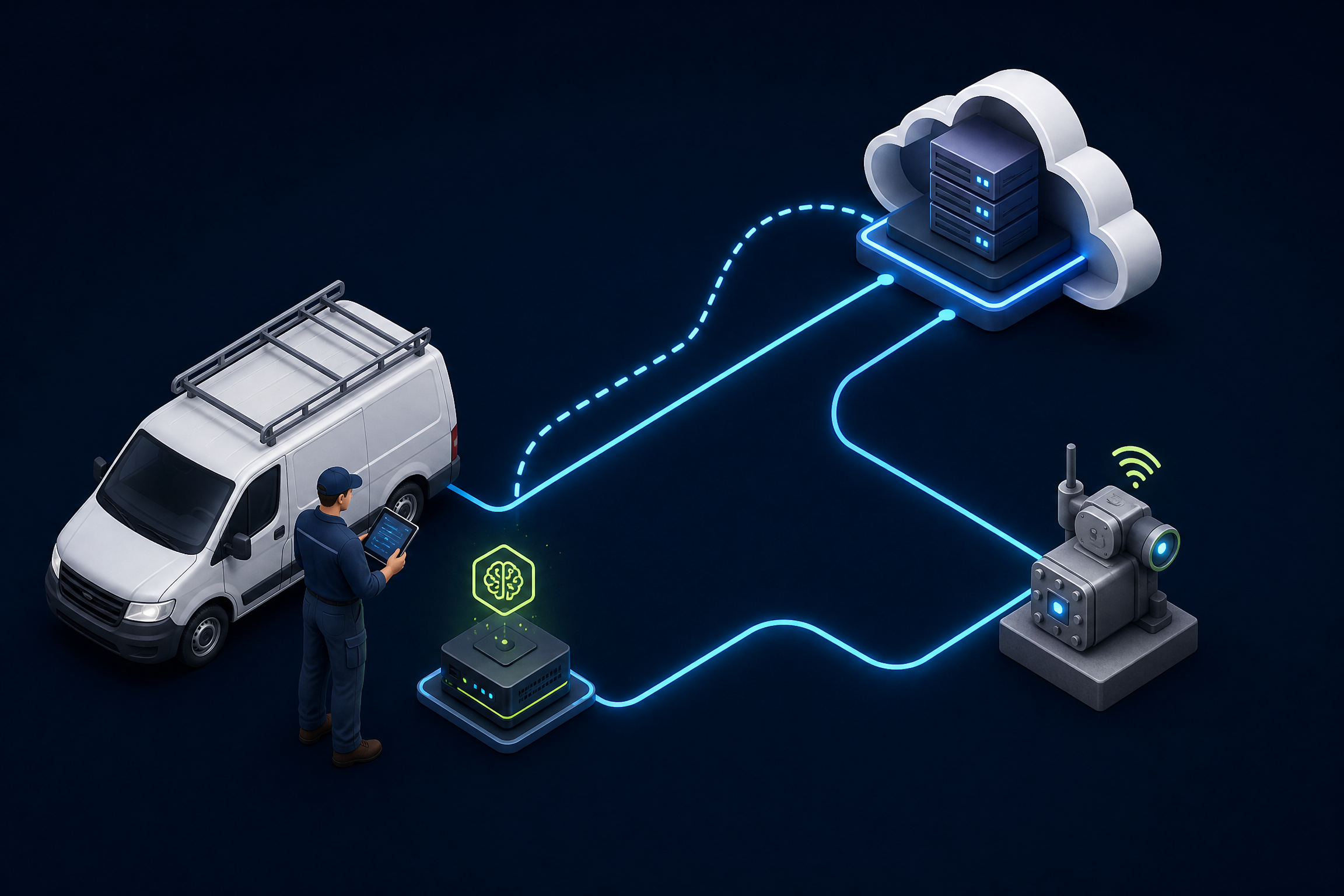
The phrase edge infrastructure can sound like a telecom project. For a field-service business, it is more practical than that. It means putting enough intelligence and usable information close to the job—in the technician’s mobile workflow, device, vehicle, or job-site environment—so a temporary disruption does not stop the operation.
The Fast Mode article discusses this in the context of distributed and mobile operations: local processing, multi-network connectivity, automatic failover, remote visibility, and simpler deployment architectures can reduce the operational consequences of unpredictable network conditions. 1 The precise technology mix will differ by business and industry. A 10-person HVAC contractor does not need the same architecture as a utility fleet or transit authority. But both need to answer the same question: What continues to work when the preferred connection does not?
The U.S. Cybersecurity and Infrastructure Security Agency makes an analogous point in its guidance for mission-critical communications: resilient and redundant technology, combined with risk management and backup plans, is key to maintaining operations when disruptions occur. 3 Field-service organizations are not emergency-communications agencies, but the continuity principle transfers directly. Your workflow needs a documented Plan B.
The Four Capabilities That Matter Most
1. Offline-first field execution
A technician should be able to open a work order, see the scope, complete required and optional tasks, capture photos, record notes, and document the job even when a connection is unavailable. Offline capability reduces the temptation to create side-channel processes that later have to be re-entered by an administrator.
NVC360 2.0 publicly describes its technician application as supporting offline mode, along with job flows, messaging, checklists, photo capture, approvals, and payments. 4 The operational point is not that every interaction can happen without a signal. It is that core job execution should not be held hostage by one.
2. Clean recovery and synchronization
The moment connectivity returns, the system should restore a single, current record of the job. That means syncing captured information to the work order rather than asking the technician to explain what happened from memory at the end of the day.
For dispatchers, clean synchronization means fewer status-chasing calls. For customers, it means the service story catches up quickly: the technician was on site, the work was completed, the relevant documentation is available, and the next communication can proceed.
3. Customer communication that does not depend on manual chasing
The “Uber-like” experience is not a gimmick. It is a promise of visibility. NVC360 2.0 positions live technician tracking, automated ETAs, and two-way client communication as core elements of its client experience. 4 When service is disrupted, automated updates and a clear mobile workflow help prevent a minor connectivity issue from becoming a client-confidence issue.
The goal is not to over-notify people. It is to make sure the right person has the right update without the dispatcher becoming a human switchboard.
4. A continuity plan beyond the app
An offline-capable app is one layer of resilience, not the whole strategy. Mission-critical mobile operations may also require device management, secure identity controls, battery policies, cellular coverage testing, carrier redundancy, local data retention rules, and escalation procedures. The right mix depends on the consequences of downtime and the complexity of the operation.
A good starting point is to map the workflow from dispatch to customer closeout and identify the points where a loss of connection creates a manual workaround. Those are the failure points worth addressing first.
The NVC360 2.0 Perspective: Build for the Job Site, Not the Perfect Signal
Too many field-service processes are designed as if every worker is sitting at a desk with stable Wi-Fi. That is not how HVAC technicians, construction teams, electrical crews, delivery drivers, logistics operators, or specialty field teams work.
NVC360 2.0 is built around the reality of mobile execution: dispatchers need live visibility; technicians need a practical mobile workflow; and clients need transparent, timely communication. The platform’s published feature set includes real-time tracking, automated ETA notifications, in-app messaging, customizable tasks, checklists, photo capture, digital approvals, payment collection, and an offline-capable mobile application. 4
The important idea is simple: resilience protects the customer experience. If the technician can keep moving, the job record stays intact, and the client is not left wondering what happened, you protect more than productivity. You protect trust.
A Practical Resilience Checklist for Field-Service Leaders
Before you invest in another point solution, ask whether your current operating model can answer the following questions.
| Leadership question | A strong answer looks like |
|---|---|
| Can a technician complete the essential parts of a job with no signal? | Core job information and required documentation remain usable in the field. |
| What happens to photos, notes, signatures, and status changes during an outage? | They are retained securely and synchronized to the correct job record when connectivity returns. |
| How does dispatch learn that a job has progressed? | The system restores a shared operational record without a chain of phone calls and spreadsheet updates. |
| What does the client experience when an ETA changes or a job is completed? | The client receives clear, branded, timely communication instead of silence or a vague manual update. |
| Which operating steps still rely on “call the office and write it down”? | Those steps are documented as risks and prioritized for workflow redesign. |
Frequently Asked Questions
What is edge infrastructure in field service?
In field service, edge infrastructure is the combination of local devices, mobile workflows, connectivity, and data-handling practices that lets a technician continue useful work close to the job site rather than depending on uninterrupted access to a central system. Its purpose is operational continuity—not technology for technology’s sake. 1
Why is offline capability important for technician productivity?
Offline capability can prevent field work from reverting to paper notes, delayed updates, and repeated data entry when a technician enters an area with weak coverage. It is most valuable when the offline workflow preserves the exact job context and restores the shared record once connectivity returns.
Does resilient mobile operations mean buying expensive new hardware?
Not necessarily. Start with your service workflow and the cost of interruption. Some businesses will benefit first from an offline-capable field service platform and clearer dispatch processes; others with complex fleets or high-consequence operations may also require network, device, and redundancy investments. The appropriate design should match the operational risk.
The Bottom Line
Your customers will not remember the technical cause of a dropped connection. They will remember whether your company kept them informed, completed the work, and made the experience feel organized.
Resilient edge infrastructure turns connectivity from a hidden dependency into a managed part of your service delivery model. With an offline-capable mobile workflow, reliable synchronization, real-time technician tracking, and automated client communication, you can keep work moving when the field becomes unpredictable.
Ready to close the gap between field execution and client confidence? Request Beta Access to NVC360 2.0 and see how an Uber-like field service experience can work for your team and your customers.
Leave a Reply