The AI Adoption Gap: Why 75% of Field Service Companies Are Falling Behind
Category: BECOMING PREFERRED
Posted on: April 30, 2026
Read time: 6 minutes
The Problem
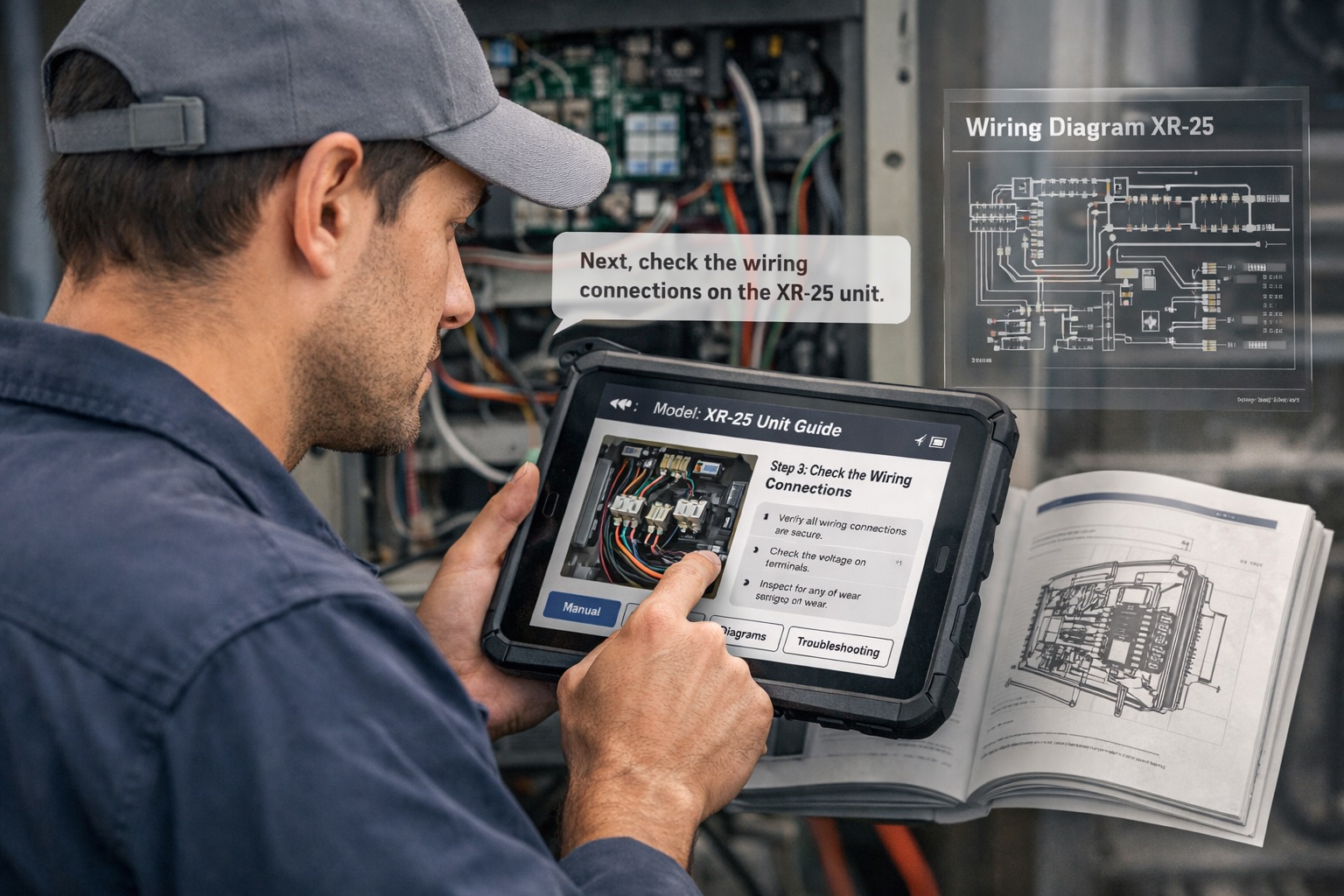
The field service industry is experiencing a profound technological divide. On one side, a small percentage of early adopters are leveraging artificial intelligence to automate dispatch, predict equipment failures, and provide seamless customer experiences. On the other side, the vast majority of service companies are still relying on manual scheduling, reactive maintenance, and fragmented communication. This divide is no longer just a difference in operational style; it has become a critical competitive gap that is rapidly reshaping the market.
Recent industry data reveals a startling reality: while the conversation around AI is ubiquitous, actual implementation in field service remains surprisingly low. A 2026 survey of over 1,000 residential specialty contractors found that only 25% are currently using AI to boost their business . Similarly, in the commercial sector, while adoption is accelerating, only 38% of contractors report measurable business impact from AI . This means that roughly 62% to 75% of field service companies are operating at a significant technological disadvantage, missing out on the efficiency and revenue gains that AI provides.
The High Cost of Inefficiency
The reluctance to adopt AI is often rooted in operational complexity, lack of trust in new technology, or concerns about upfront costs . However, the cost of inaction is far greater. Traditional service models—characterized by manual routing, paper-based work orders, and reactive “break-fix” approaches—are increasingly unsustainable in a market where customer expectations are higher than ever and skilled labor is scarce.
“The next AI leaders in the commercial and construction markets will be defined by how seamlessly intelligence is embedded across the entire workflow. Companies that unify their systems, sharpen execution, use real-time data to protect margins, and accelerate cash flow will transform operational complexity into a competitive advantage.” – Alex Kablanian, SVP at ServiceTitan
The financial impact of this inefficiency is stark when comparing traditional operations to their AI-powered counterparts. According to a 2026 commercial service industry report, traditional service companies are growing revenue at a modest 9% annually, often with compressing margins due to rising labor costs. In contrast, AI-powered operations are experiencing explosive revenue growth of 52% year-over-year . This growth is driven not by charging more for the same services, but by offering superior reliability, predictive maintenance, and operational efficiency that justifies premium contract values.
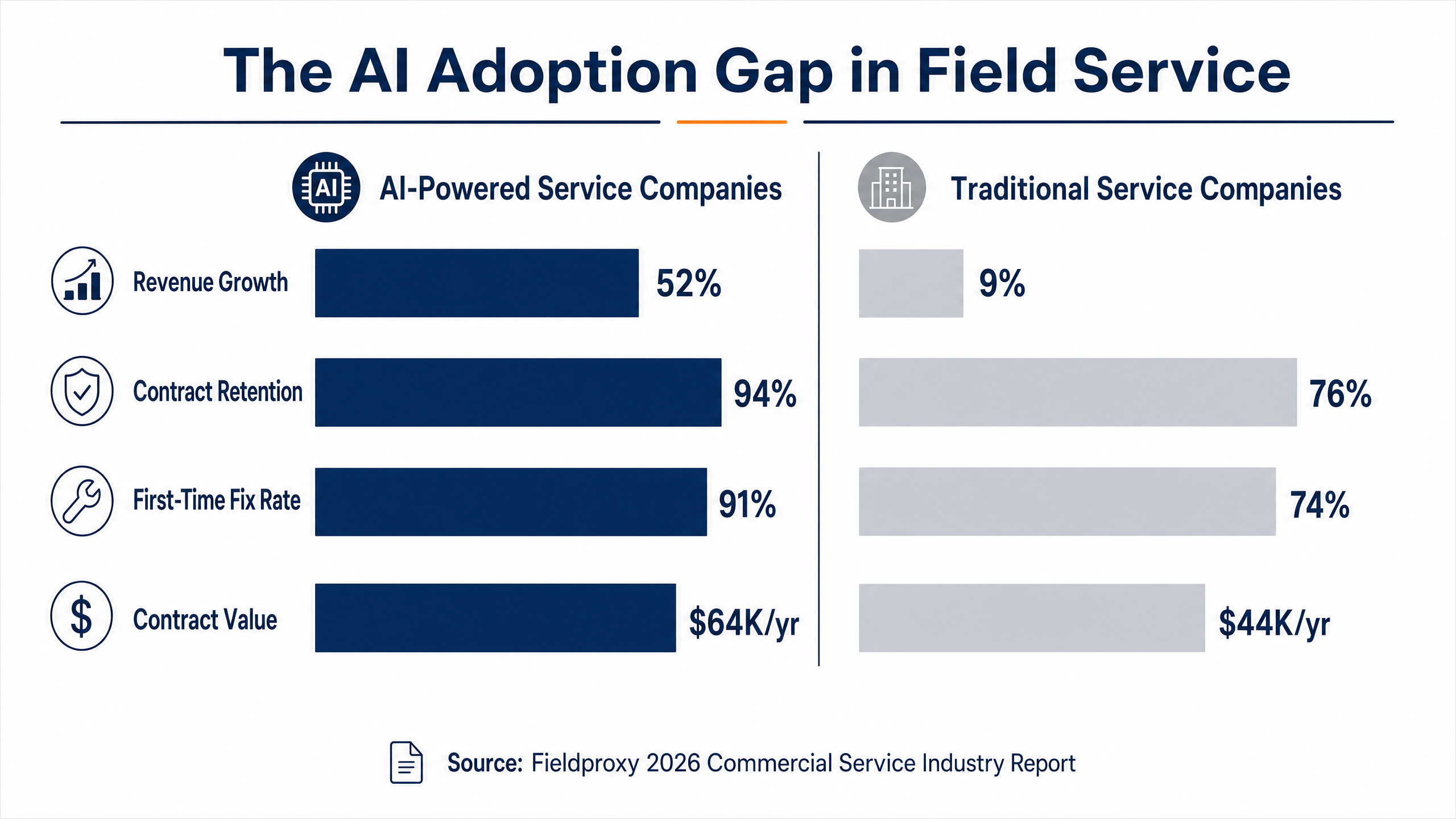
The performance gap extends to critical operational metrics as well. The industry average First-Time Fix Rate (FTFR) hovers around 74%, meaning one in four service calls requires a costly return visit . For companies equipped with AI diagnostic and dispatch tools, that rate jumps to an impressive 91% . This dramatic improvement in FTFR directly translates to reduced truck rolls, lower fuel costs, and significantly higher customer satisfaction.
A Better Way: Streamlining Field Work and Communication
Bridging the AI adoption gap requires more than just purchasing new software; it requires a fundamental shift in how field service operations are managed. Technology must be viewed not as a replacement for skilled technicians, but as a force multiplier that empowers them to do their jobs more effectively. This is where intelligent platforms like NVC360 2.0 come into play, offering a unified solution that streamlines workflows and automates complex processes.
By integrating AI and automation into the core of field service management, companies can eliminate the friction that slows down operations. Intelligent scheduling algorithms can instantly match the right technician to the right job based on skills, location, and parts availability, optimizing routes to minimize travel time. Automated communication tools keep customers informed at every step, reducing inbound status inquiries and improving the overall service experience.
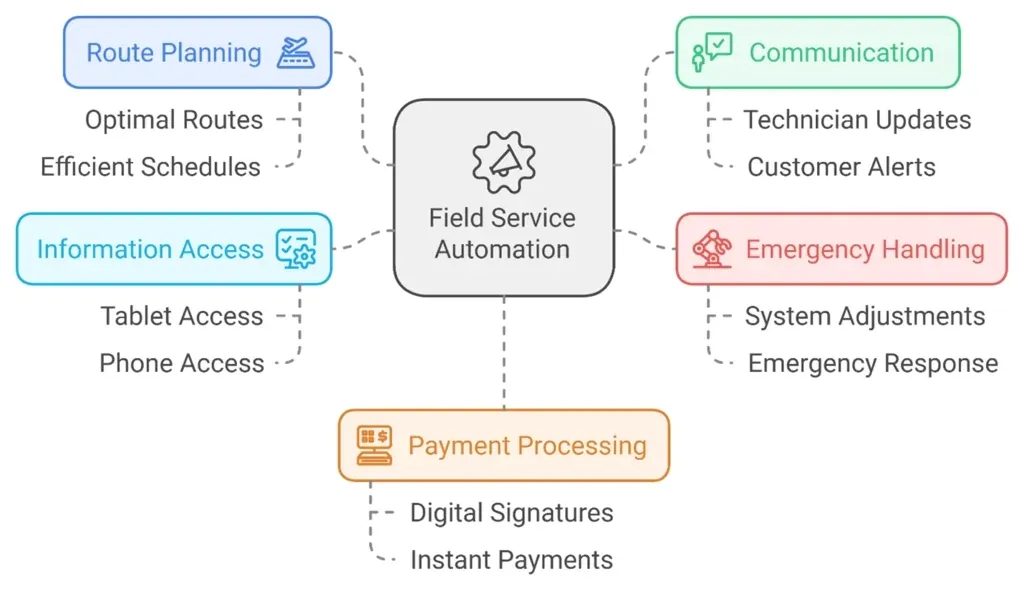
Furthermore, AI-driven insights provide dispatchers and managers with the real-time visibility needed to make proactive decisions. Instead of reacting to emergencies, service companies can anticipate issues, optimize inventory, and deploy resources more strategically. This shift from reactive to proactive service is the key to unlocking higher margins and building long-term customer loyalty in a competitive market.
The “Uber-Like” Experience in Action
Consider the experience of a commercial property manager dealing with an unexpected HVAC failure. In a traditional service scenario, the manager places an emergency call, waits for an indefinite period without updates, and hopes the technician arrives with the correct parts. This lack of transparency leads to frustration and extended downtime for the building.
Now, imagine the same scenario powered by NVC360 2.0. The moment the service request is logged, the system automatically identifies the most qualified, nearest technician and dispatches them with optimized routing. The property manager receives an immediate notification with a live ETA and a link to track the technician’s progress in real-time—an “Uber-like” experience that provides complete transparency.
Upon arrival, the technician has access to the equipment’s full service history, digital manuals, and dynamic checklists directly on their mobile device. They can capture photos, record voice notes, and process integrated payments or signatures seamlessly before leaving the site. The result is a faster resolution, a fully documented service visit, and a highly satisfied customer who is far more likely to renew their service contract. In fact, AI-powered commercial service companies report contract retention rates of 94%, compared to just 76% for traditional providers .
Conclusion: The Future of Field Service
The data is clear: the AI adoption gap is widening, and the companies that fail to embrace intelligent automation risk being left behind. While 75% of the industry hesitates due to perceived complexity or cost, the early adopters are capturing market share, commanding higher contract values, and delivering superior customer experiences. The future of field service belongs to those who use technology to empower their workforce and streamline their operations.
To remain competitive, service companies must transition from fragmented, manual processes to unified, intelligent platforms. By doing so, they can not only reduce operational costs but also transform their service delivery into a powerful driver of revenue growth and customer loyalty.
Ready to transform your field service operations?
Request Beta Access to NVC360 2.0 and start delivering an “Uber-like” experience to your customers while maximizing your team’s efficiency.
References
[1] Survey: 25% of Residential Contractors Using AI to Boost Business
[2] ServiceTitan Report Finds AI Adoption More Than Doubles Among Commercial Contractors
[3] Commercial Service Industry Report 2026: AI Agents Drive 52% Revenue Growth
The AI Adoption Gap: Why 75% of Field Service Companies Are Falling Behind
Introduction: The Problem
The High Cost of Inefficiency
A Better Way: Streamlining Field Work and Communication
The “Uber-Like” Experience in Action
Conclusion: The Future of Field Service
Ready to transform your field service operations?
References
terbinafine mechanism treatment overview
terbinafine mechanism treatment overview
ivermectin scabies medical overview
ivermectin scabies medical overview
minoxidil pk elimination kinetics
minoxidil pk elimination kinetics
vardenafil 10 mg data
vardenafil 10 mg data
orlistat mechanism insights
orlistat mechanism insights