Every field service business eventually faces a fundamental strategic choice: are you going to be the cheapest option in your market, or are you going to be the preferred option?
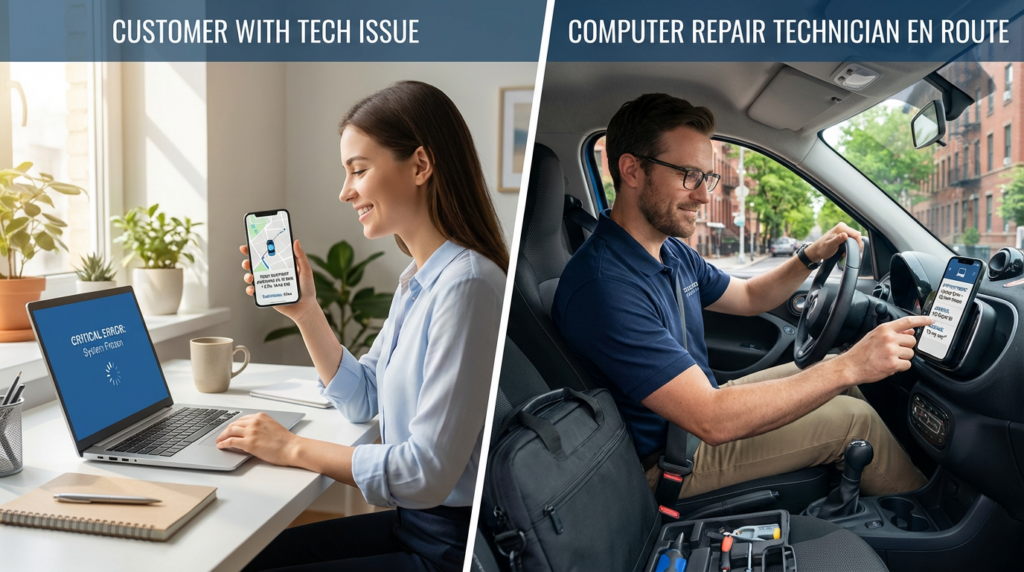
For decades, the trades have been plagued by a race to the bottom. Contractors routinely slash their bids, compromise on materials, and squeeze their labor costs just to win the job. But competing on price is a dangerous game with a finite runway. The cost leadership strategy inevitably leads to margin compression, high employee turnover, and a business model that is entirely dependent on volume to survive.
The alternative is becoming the preferred provider. This strategy requires a deliberate shift in value proposition—moving away from “we are the cheapest” to “we provide the best, most reliable experience.”
The data proves that this isn’t just a marketing theory. Becoming the preferred provider in your market is highly correlative to exponential EBITDA (Earnings Before Interest, Taxes, Depreciation, and Amortization) growth. The contractors who figure this out are pulling away from the pack, while the price-cutters are slowly suffocating their own businesses.
The Mathematical Reality of Customer Preference
When a customer prefers your brand over the competition, it fundamentally changes the economics of your business. Preference drives three massive financial levers: premium pricing power, dramatically lower acquisition costs, and increased lifetime value.
The correlation between customer preference and financial performance is staggering. An exhaustive 18-year Customer Experience ROI Study by Watermark Consulting tracked the stock performance of companies identified as customer experience (CX) leaders versus CX laggards. The results are undeniable: CX leaders generated a total return that was 7.8 times greater than the laggards . Over the past five years, that performance disparity has more than doubled.
Why does this happen? According to the researchers, higher revenues combined with a more competitive cost structure translate directly into superior profitability .
This is further supported by a 2026 academic study published in the International Review of Management and Marketing, which analyzed 135 international companies over a two-decade period. The researchers found a robust, positive association between brand value and EBITDA. Specifically, they quantified that a $1 increase in brand value correlates with a $1.76 gain in turnover and a $0.16 rise in net income .
When you are the preferred provider, you are no longer a commodity. You are an asset.
How Preference Drives EBITDA Growth in Field Service
In the field service industry, the impact of being preferred is even more pronounced because the cost of failure is so high for the customer. A bad haircut is an annoyance; a botched plumbing repair or a no-show HVAC technician in the middle of winter is a crisis.
When a field service company establishes itself as the preferred, reliable choice, the financial metrics transform rapidly across three specific areas:
1. The Premium Pricing Advantage
You do not have to be the cheapest to win the job. In fact, pricing yourself too low can signal low quality to a discerning buyer.
A 2025 survey of over 1,000 U.S. homeowners revealed that 72% of respondents would gladly pay 10% more for a Pro with a better customer service reputation . Broader research by Forrester confirms this, showing that CX leaders command a 16% price premium, which flows directly to the profit margin . When you can charge 10% to 16% more for the exact same labor and materials simply because the customer trusts you more, your EBITDA multiplies rapidly.
2. The Retention Multiplier
Acquiring a new customer is expensive. According to the Harvard Business Review, acquiring a new customer costs 5 to 25 times more than retaining an existing one .
When you are the preferred provider, you stop paying for customer acquisition over and over again. Bain & Company’s landmark research on customer loyalty economics proves that increasing customer retention rates by just 5% increases profits by 25% to 95% . Furthermore, repeat customers spend up to 67% more in their third year of buying from a company .
3. The Referral Engine
In the trades, reputation is revenue. A Harvard Business Review study analyzing Yelp and Google reviews found that a mere 1-star increase in average rating can result in a 5% to 9% boost in revenue .
When you deliver a preferred experience, your customers become your marketing department. According to Housecall Pro, 73% of homeowners say they would refer a Pro after an excellent experience . This organic, zero-cost acquisition channel dramatically reduces your marketing spend, dropping more revenue straight to the bottom line.
| Metric | Price Leader Strategy | Preferred Provider Strategy | Financial Impact |
| Pricing Power | Constant downward pressure | Commands 10-16% premium | Direct increase to gross margin |
| Customer Acquisition | High cost, constant churn | High retention, organic referrals | Lower marketing spend, higher ROI |
| Profitability (EBITDA) | Volume-dependent, low margin | Margin-driven, exponential growth | 5% retention boost = 25-95% profit increase |
| Market Valuation | Trails industry averages | Outperforms laggards by up to 7.8x | Higher multiple upon business exit |
Becoming the Preferred Provider with NVC360 2.0
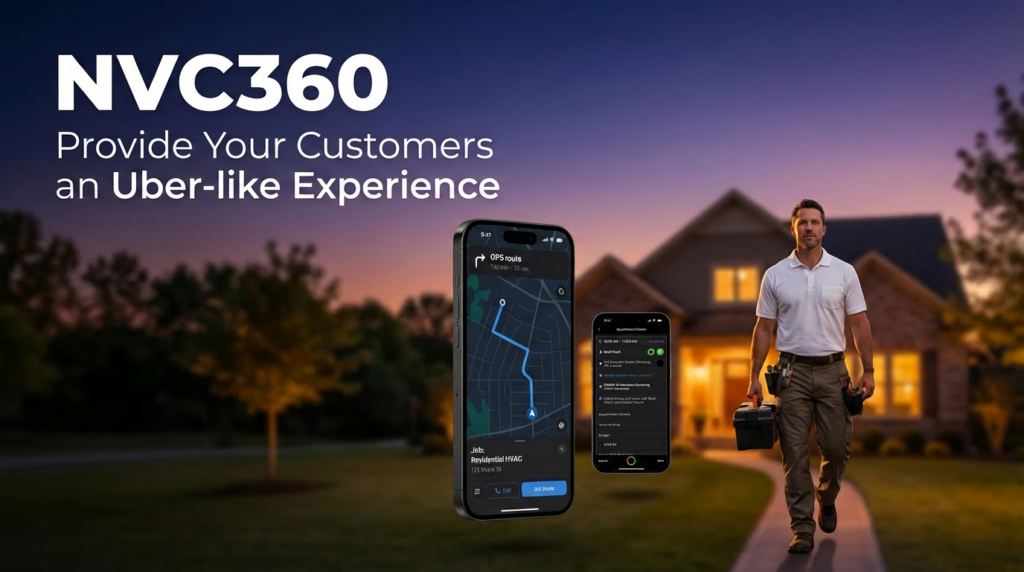
The data is clear: being preferred drives EBITDA. But how does a traditional field service company actually make that transition? You cannot simply declare yourself the preferred provider; you have to engineer an experience that earns that title.
This is exactly why NVC360 2.0 was built.
NVC360 2.0 is not just a scheduling tool; it is a customer preference engine. It provides the technological infrastructure necessary to deliver the “Uber-style” experience that modern consumers demand, instantly separating your business from the price-cutting competitors who are still running their operations on whiteboards and text messages.
Proactive Communication Builds Trust
Seventy-one percent of service complaints stem from poor communication rather than technical issues . NVC360 2.0 eliminates this friction by providing automated, two-way messaging and live ETA tracking powered by Google APIs. When your customer receives a text message with a live map showing exactly when your technician will arrive, you instantly become the reliable, preferred choice. In fact, customers who receive proactive service updates are 3.5 times more likely to recommend a service provider .
Transparency Justifies the Premium
To command a premium price, you must provide premium transparency. NVC360 2.0’s robust work order functionality allows technicians to capture photos, record voice notes, and attach files directly to the job record. This documentation is seamlessly shared with the client, proving the value of the work performed. When a customer can literally see the quality of your work on their smartphone, they stop arguing about the price.
Frictionless Operations Drive Loyalty
NVC360 2.0 streamlines the entire customer journey, from the initial digital booking to integrated payment processing and signature capture in the field. By removing the friction from the transaction, you make it incredibly easy for the customer to say “yes” to you again and again.
Stop Competing on Price
The race to the bottom has no winners. If your only value proposition is being the cheapest option, your margins will continue to shrink, and your EBITDA will stagnate.
The path to exponential growth requires a commitment to becoming the preferred provider in your market. By leveraging NVC360 2.0 to deliver an unmatched, transparent, and highly communicative customer experience, you can command premium pricing, drastically improve retention, and watch your EBITDA soar.
It is time to stop competing on price and start competing on preference.
References
[1] Watermark Consulting. “The Customer Experience ROI Study.” April 2026.
[3] Housecall Pro. “Home Service Customer Service Report: Trends & Statistics.” December 2025.
[4] Forrester Research. “How to Quantify the Financial Impact of Customer Experience.”
hello world
hello world
toradol onset overview
toradol onset overview
Good a blog toper
orlistat side effect data
orlistat side effect data
Honestly this platform changed how I game online. Deposits go through in no time and the bonus terms are actually fair. I love how easy the interface is to navigate even on my phone. Highly recommend checking it out. mex66
I have tried almost every betting site out there and this one really stands out. The mobile app runs like butter and I never experience lag during live games. Plus the VIP program actually rewards loyal players instead of just promising things. Love it. mmgmm11
I really enjoy how straightforward everything is on this platform. The bonus terms are clearly written and the games run smoothly on both desktop and mobile. It is rare to find such a well maintained site with fast payout processing. Start your journey at mxapuestas360
nexus darknet market url wethenorth market darknet
torzon darkweb url https://darknetmarketworld.com/