
End the 4-hour service window – forever!
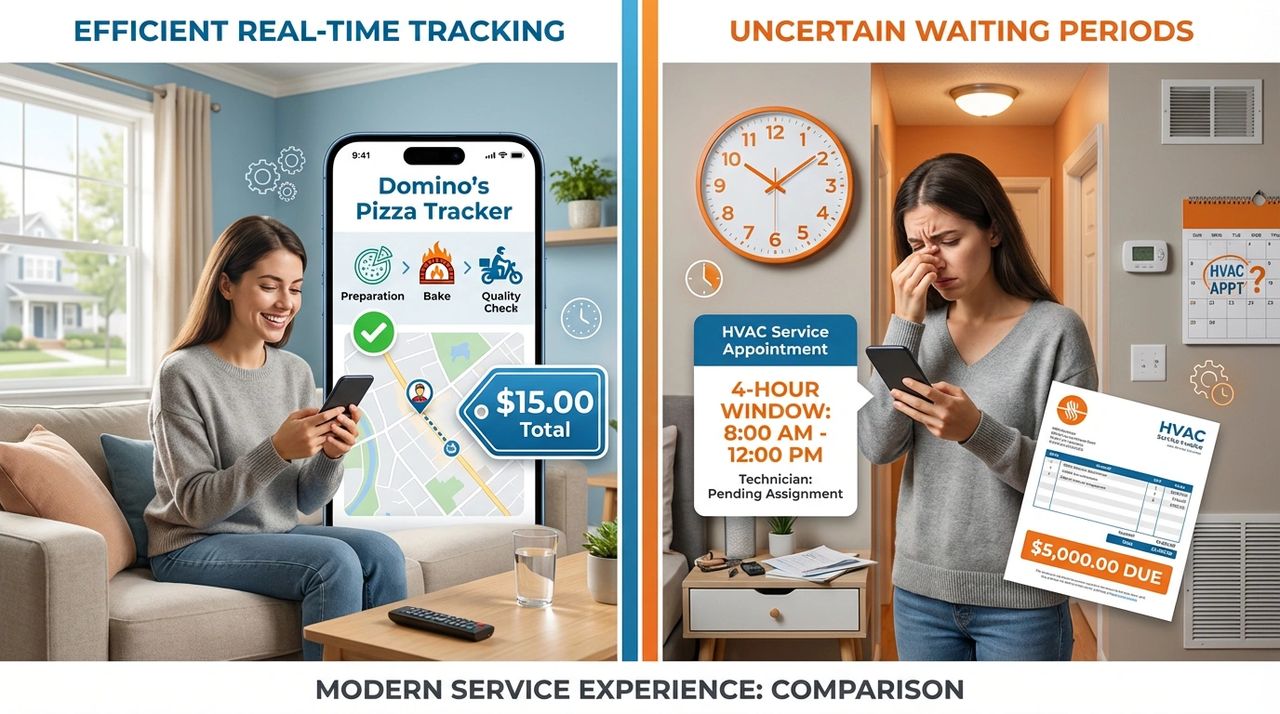
Last night, I ordered a $15 pizza. Within seconds, I received a confirmation text. I watched in real-time as my order moved through preparation stages: “Order received,” “Pizza in the oven,” “Quality check complete.” I tracked the delivery driver’s exact location on a map. A notification arrived: “Your driver is 2 minutes away.” The doorbell rang exactly 28 minutes after I clicked “Order.”
This morning, I scheduled a $4,500 HVAC repair. The response: “We’ll be there between 8 AM and noon.”
I cleared my entire morning. I rescheduled two client meetings. I turned down an $800 consulting opportunity. For four hours, I sat by the window, unable to leave, unable to focus, wondering when the technician would actually arrive.
The $15 transaction delivered a superior customer experience than the $5,000 one. And I’m not the only person noticing this absurdity.
The Customer Experience Paradox
We live in an era of unprecedented transparency. According to recent industry data, 156 million people use the Uber app monthly, all expecting—and receiving—real-time tracking of their ride. Amazon delivers over 450 million packages annually with precise delivery windows, often accurate to the hour. Even grocery delivery services show you exactly which aisle your shopper is in.
Yet when it comes to field service—HVAC repairs, plumbing emergencies, electrical work—customers are asked to accept service windows that would be laughable in any other industry.
A study from Zendesk’s 2026 Customer Experience Trends reveals that 72 percent of customers now expect immediate service response. The research shows that 64 percent of customers will actively spend more with businesses that resolve issues where they already are, rather than forcing them to wait at home for hours.
The gap between expectation and reality has never been wider, and field service contractors are on the wrong side of that gap.
The Timeline of Transparency
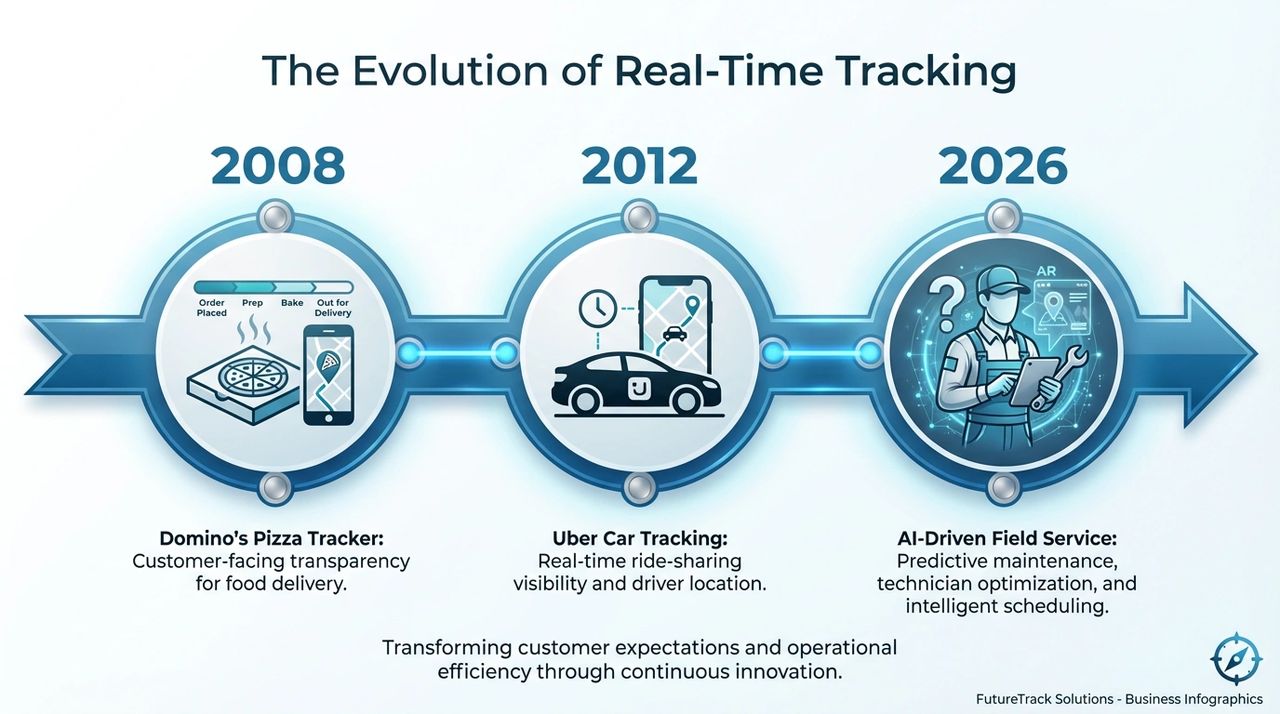
Understanding how we arrived at this paradox requires looking at the evolution of real-time tracking across industries.
2008: Pizza Delivery Sets the Standard
Domino’s launched its Pizza Tracker in January 2008, fundamentally changing customer expectations for all delivery services. The innovation wasn’t just about technology—it was about respect. By showing customers exactly what was happening with their order, Domino’s acknowledged that their time and peace of mind mattered.
The impact was immediate and measurable. The Pizza Tracker became such a competitive advantage that it helped transform Domino’s from a struggling chain into the largest pizza company in the world. Industry analysts credit the technology with reducing “where’s my pizza?” calls by over 75 percent while simultaneously increasing customer satisfaction scores.
2012: Uber Makes Tracking Universal
When Uber launched its rideshare service with built-in real-time tracking, it normalized the expectation that customers should always know where their service provider is. By 2026, over 150 million monthly active users expect this level of transparency as a baseline, not a premium feature.
The Uber effect extended far beyond ridesharing. It fundamentally reset customer expectations for any service that involves someone coming to you. If customers can track a $20 ride with precision, why should they accept uncertainty for a $5,000 service call?
2015-Present: E-Commerce Perfects Precision
Amazon and other e-commerce platforms took tracking to the next level, providing delivery windows measured in hours, not days. Research shows that 63 percent of consumers now consider full visibility throughout the delivery process to be essential, not optional.
2026: Field Service Still Waiting
While nearly every consumer-facing industry adopted real-time tracking over the past 15 years, field service largely stood still. According to field service industry research, only 52 percent of service-centric organizations have adopted modern field service software. Among smaller contractors, that number drops below 40 percent.
The question isn’t whether customers expect real-time tracking. They do. The question is: how much longer can field service contractors afford to ignore what every other industry figured out years ago?
The Customer Experience Comparison Matrix
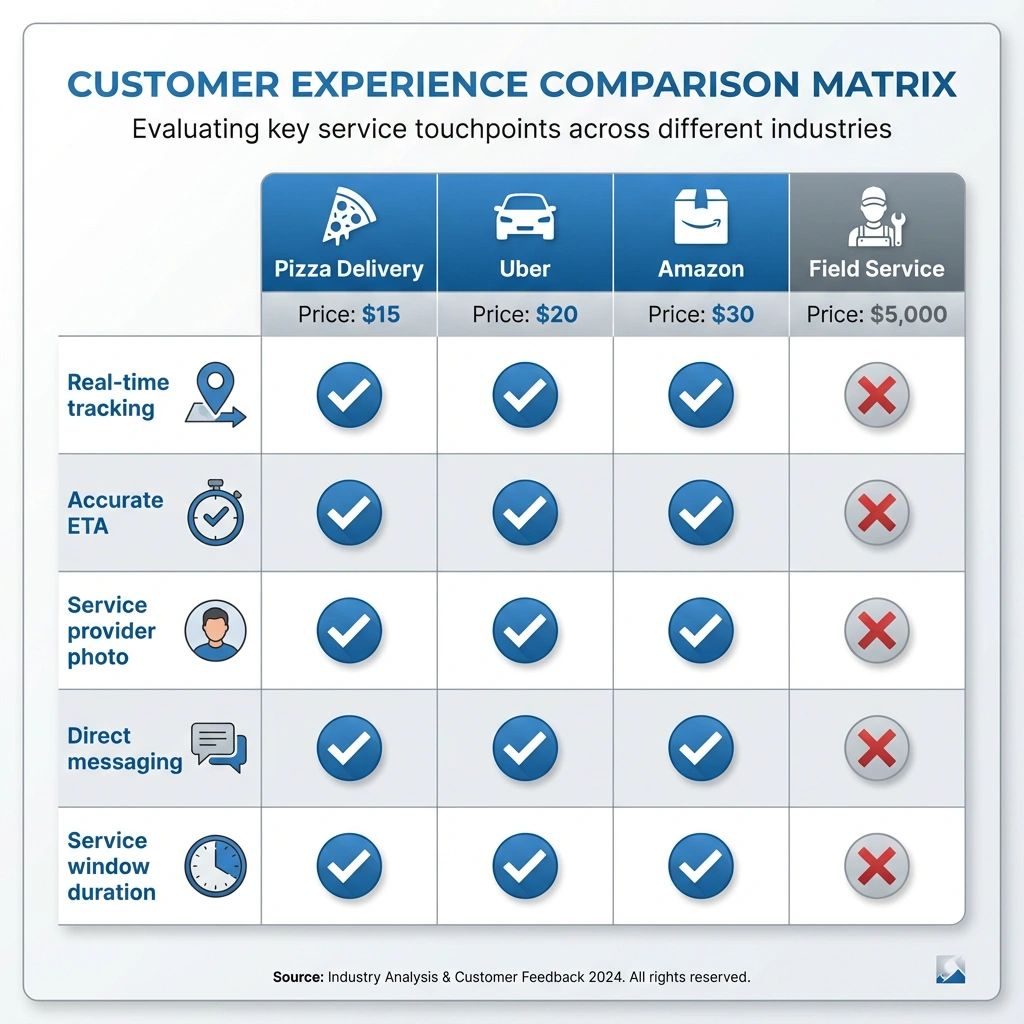
Let’s examine exactly what customers receive across different service industries:
Pizza Delivery ($15 transaction)
- Real-time order tracking: Yes
- Accurate ETA: Within 5 minutes
- Service provider information: Driver name and rating
- Direct messaging capability: Yes
- Service window: 30-45 minutes
Uber/Lyft ($20 transaction)
- Real-time vehicle tracking: Yes
- Accurate ETA: Within 1 minute
- Service provider information: Photo, name, rating, vehicle details
- Direct messaging capability: Yes
- Service window: 5-10 minutes
Amazon Delivery ($30 transaction)
- Real-time package tracking: Yes
- Accurate ETA: 2-hour delivery window
- Service provider information: Carrier details
- Photo proof of delivery: Yes
- Service window: 2 hours (often narrower)
Field Service ($5,000 transaction)
- Real-time technician tracking: Rarely
- Accurate ETA: 4-hour window (often missed)
- Service provider information: Company name only
- Direct communication: Phone tag with office
- Service window: 4+ hours
The $15 pizza transaction provides more transparency, better communication, and greater respect for the customer’s time than a $5,000 HVAC repair. This isn’t a technology problem. It’s a priority problem.
Why Field Service Got Left Behind
The excuses for this lag are familiar:
“Our service is more complex than pizza delivery.” Perhaps. But hospitals now provide real-time updates on surgical procedures. Amazon coordinates millions of packages daily across complex logistics networks. Complexity isn’t an excuse—it’s been solved in far more demanding environments.
“Our customers don’t expect real-time tracking.” Your customers are the same people ordering pizza with tracking, riding in Ubers, and watching Amazon packages approach. They absolutely expect it. They’re just not telling you—they’re quietly switching to competitors who provide it.
“It’s too expensive to implement.” Domino’s implemented Pizza Tracker in 2008 when their profit margins were under 3 percent. They found it affordable because they understood the cost of not implementing it was higher. Modern field service software costs less than one lost customer per year.
“We’ve always done it this way.” Blockbuster always rented movies from stores. Borders always sold books in retail locations. “We’ve always done it this way” is the corporate equivalent of surrender.
According to field service management research, 70 percent of organizations have already invested in some form of AI and mobile technology. The question isn’t whether technology adoption will happen—it’s whether you’ll lead the change or be left behind by it.
What Your Customers Are Really Comparing
Here’s what frustrates customers most: the cognitive dissonance of modern life.
A typical Monday morning for your customer:
- 7:00 AM: Checks Amazon delivery (package arriving between 2:00-4:00 PM)
- 7:15 AM: Orders breakfast via Uber Eats (tracks driver in real-time)
- 8:00 AM: Starts four-hour wait for HVAC technician with zero visibility
- 8:30 AM: Receives text from teenager showing their real-time location
- 9:00 AM: Watches FedEx truck approach on tracking map
- 10:00 AM: Calls HVAC company: “When will the technician arrive?” “Still running behind, probably around noon.”
- 12:15 PM: Technician arrives late. Customer has lost half their workday.
Every interaction in their life provides transparency and respect for their time—except yours.
The Competitive Threat You’re Not Seeing
While established contractors debate whether real-time tracking is necessary, new market entrants are building their entire value proposition around superior customer experience.
Tech-enabled service platforms backed by venture capital are entering the market with Uber-like customer experiences built into their core offering. They’re not better technicians than you. They’re just better at treating customers the way every other modern business does.
Traditional contractors often don’t even know why they’re losing bids. A potential customer compares options: one contractor offers traditional four-hour windows and phone-call updates. Another provides real-time tracking, 15-minute arrival notifications, and direct technician messaging. The technical skills and pricing may be identical. The customer experience is not.
According to research from multiple customer satisfaction studies, 95 percent of consumers say customer service impacts their brand loyalty decisions. After one poor experience, loyalty begins eroding. After multiple experiences, it disappears. Field service is hemorrhaging customers to competitors who simply acknowledge that customer time has value.
The Mathematics of Modernization
The investment required to solve this problem is remarkably modest compared to the cost of inaction.
Modern real-time tracking platforms typically cost $150-$300 per user monthly. For a seven-person operation (five technicians, two office staff), annual software costs range from $12,600 to $25,200.
The cost of not implementing real-time tracking, as detailed in field service industry research:
- Lost productivity from scheduling inefficiency: $50,000+ per technician
- Customer churn from poor experience: 15-20 percent of customer base
- Administrative overhead handling “where’s my technician?” calls: $6,000+ annually
- Inability to command premium pricing: 10-15 percent margin erosion
For a typical five-technician operation with 500 customers averaging $5,000 lifetime value, the annual cost of maintaining traditional service windows exceeds $600,000. Software costing $25,000 annually doesn’t seem expensive when the alternative costs twenty times more.
But this analysis still misses the fundamental point. This isn’t about return on investment. It’s about survival in a market where customer expectations have permanently shifted.
From Pizza Tracker to Field Service Leader
The good news: solving this problem has never been easier or more affordable. Modern field service management platforms integrate with existing systems, deploy in days rather than months, and provide immediate value through:
- Automated customer communications (text and email)
- Real-time GPS tracking with ETA updates
- Mobile apps for technicians
- Direct customer-technician messaging
- Intelligent dispatching and routing
Forward-thinking contractors implementing these systems report consistent results:
- 60-75 percent reduction in “where’s my technician?” calls
- 15-25 percent improvement in technician efficiency
- Customer satisfaction scores increasing from low 4s to high 4.7+ ratings
- Positive online reviews mentioning “great communication” and “respected my time”
- Measurable increases in repeat business and referrals
The Path Forward
Eighteen years ago, Domino’s revolutionized pizza delivery by acknowledging that customers deserve transparency. Fourteen years ago, Uber made real-time tracking the baseline expectation for any service coming to you. Today, even $15 pizzas come with better customer experience than most $5,000 field service calls.
The field service industry stands at a critical inflection point. Customer expectations have permanently changed. The technology to meet those expectations exists and is accessible. The competitive landscape is shifting toward providers who prioritize customer experience.
The only remaining variable is timing: will you lead this transition, or will you explain to future clients why your competitor’s “inferior” technical skills paired with superior customer communication won you the business you thought was yours?
Your customers are already comparing you to their pizza delivery experience. The question is: will you meet their expectations, or will you give them a reason to find a contractor who does?
The pizza has arrived. The technician is still somewhere in a four-hour window. Your customers are paying attention to the difference.
About NVC360
NVC360 brings real-time, Uber-like precision to field service operations through rapid-deployment technology that integrates with your existing systems. While enterprise solutions require months of implementation, NVC360 deploys in days, delivering immediate improvements to customer satisfaction and operational efficiency. Learn how contractors are transforming their customer experience at www.nvc360.com.
Contact: NVC360 | 423 Main Street, Winnipeg, Manitoba R3B 1B3 | contact@nvc360.com
Sources:
- Domino’s corporate history and Pizza Tracker launch documentation (2008)
- Uber Technologies Inc. quarterly reports and user statistics (2025-2026)
- Zendesk, Customer Experience Trends 2026
- Field Service Management industry research and adoption studies (2024-2026)
- American Customer Satisfaction Index (ACSI) data
- Consumer delivery tracking survey data (2025)
- Field service software adoption statistics
Leave a Reply