
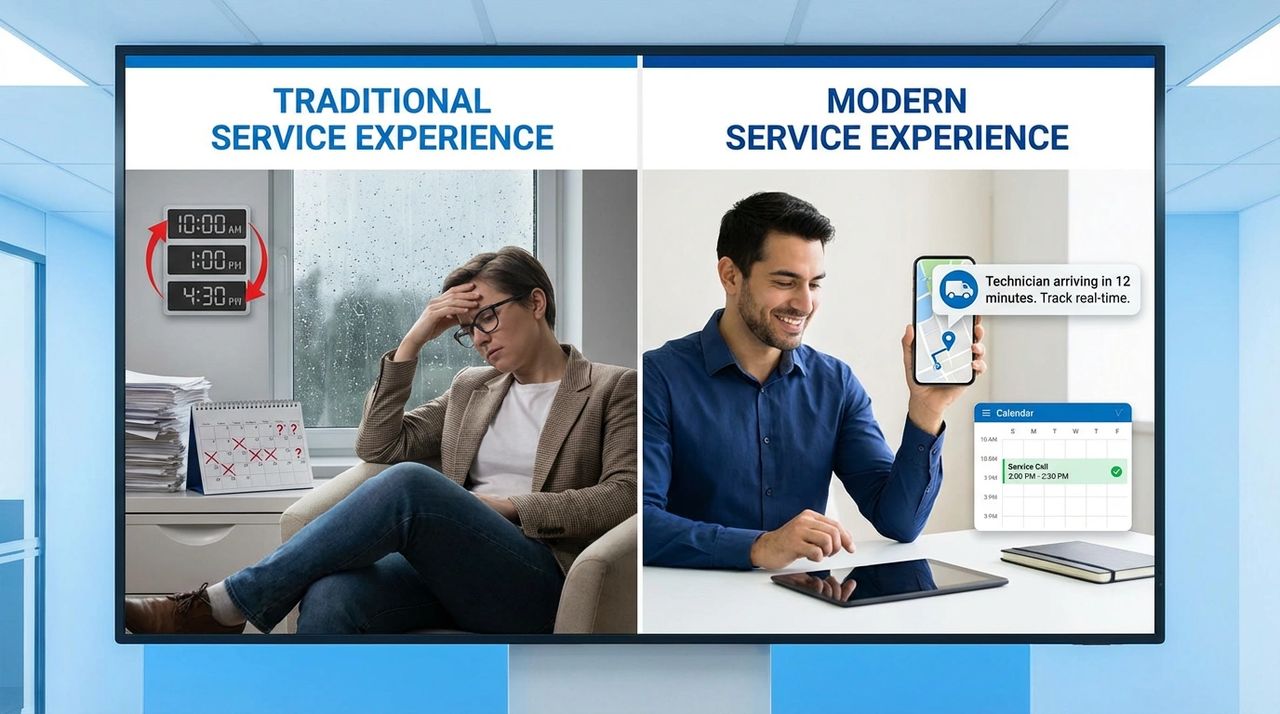
Every year, North American homeowners collectively lose over one billion hours waiting for service appointments. That’s not a typo. According to data analyzed from Bureau of Labor Statistics time-use surveys, the cumulative time spent waiting for HVAC technicians, plumbers, electricians, and other field service professionals equals approximately 1.02 billion hours annually across the United States.
To put this staggering figure in perspective: if you lined up everyone currently waiting for a service appointment, the queue would stretch around the Earth three times. That’s 116,438 years of human life spent staring out windows, checking watches, and wondering when the technician will actually arrive.
But here’s what should concern every field service contractor: this isn’t just a consumer frustration problem. It’s a brand loyalty crisis that’s costing your business tens of thousands of dollars in lost revenue every single year.
The Customer Experience Gap Is Widening
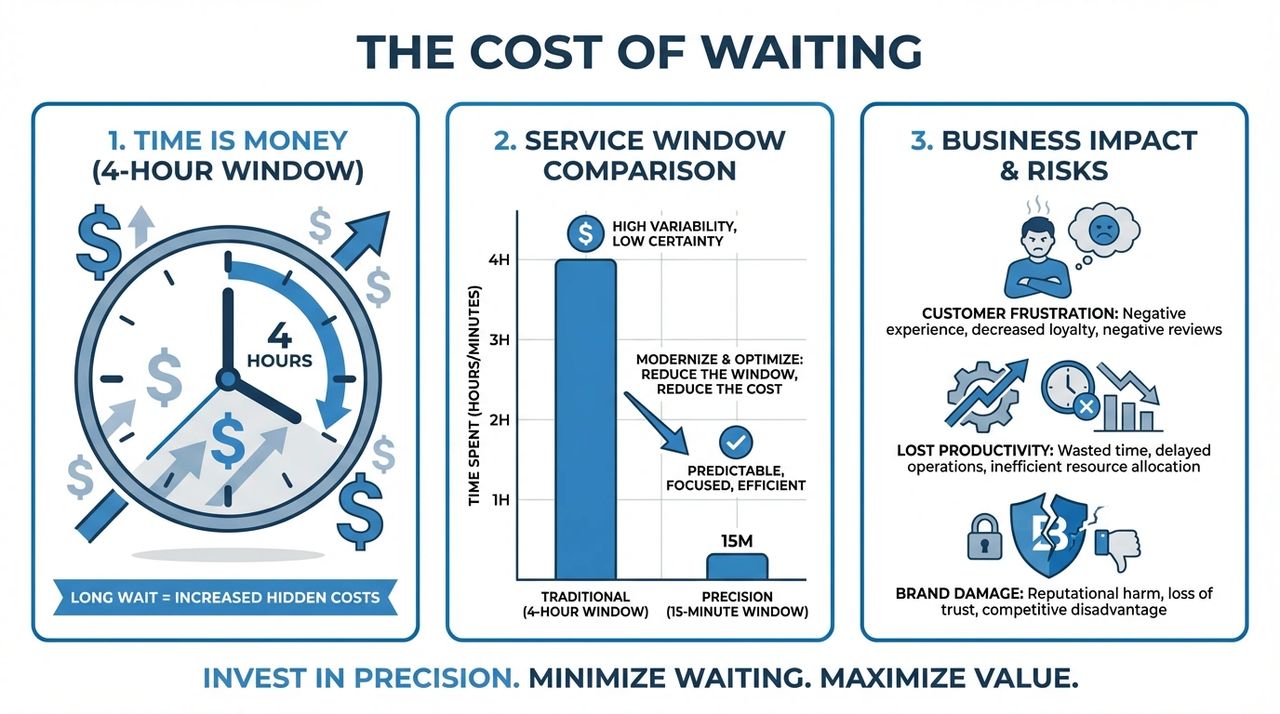
Modern consumers have fundamentally different expectations than they did even five years ago. According to Zendesk’s 2026 Customer Experience Trends report, 72 percent of customers now expect immediate service, while 64 percent will spend more money with businesses that resolve their issues where they already are.
The gap between expectation and reality has never been wider. Customers track their $15 pizza delivery in real-time. They know exactly when their Amazon package will arrive—often down to the hour. They watch their Uber driver approach on a map. Yet when they book a $5,000 HVAC repair, they’re asked to wait in a four-hour window with zero visibility.
This cognitive dissonance is destroying brand loyalty faster than most contractors realize.
The Hidden Costs of “We’ll Be There Between 8 and Noon”
Research from Harvard Business Review reveals that acquiring new customers costs between 5 and 25 times more than retaining existing ones. Yet many contractors don’t realize they’re hemorrhaging customers through poor service window management.
Consider the typical five-technician operation running eight jobs per day with traditional four-hour windows. The business impact breaks down as follows:
Direct Productivity Loss: Technicians build in 30-minute buffer time for each appointment to account for scheduling uncertainty. At eight jobs per day across 250 working days, that’s 1,000 hours per technician annually—$50,000 in lost revenue per technician at standard service rates. For five technicians, that’s $250,000 in opportunity cost.
Customer Churn Impact: Industry data shows that 15 to 20 percent of customer churn stems from poor service experience rather than price or technical quality. For a contractor with 500 customers averaging $5,000 in lifetime value, losing just 75 customers annually represents $375,000 in lost lifetime revenue.
Administrative Overhead: Customer service representatives spend an average of 75 minutes daily handling “where’s my technician?” calls. That’s over 300 hours annually at $20 per hour—$6,250 in labor costs addressing anxiety that real-time tracking would eliminate entirely.
According to data from multiple field service management studies, companies implementing real-time tracking technology report an average 60 to 75 percent reduction in these status inquiry calls, freeing staff to focus on revenue-generating activities.
What Your Customers Are Really Thinking
A recent Salesforce State of Service report found that 95 percent of consumers say customer service impacts their brand loyalty decisions. The field service industry lags significantly behind other sectors in meeting these expectations.
When customers book a four-hour service window, they’re not just giving you their time—they’re making significant sacrifices. Homeowners take time off work, costing an average of $140 in lost wages for a half-day absence. They cancel meetings, reschedule appointments, and rearrange their entire day around your window. Parents coordinate childcare. Remote workers lose productive hours.
And then, in far too many cases, the technician doesn’t arrive within the promised window at all.
Each instance chips away at the relationship between contractor and customer. According to Desk365’s 2026 customer service research, 93 percent of customers are likely to make repeat purchases from companies offering excellent service—but the inverse is equally true. After one poor experience, customer loyalty begins eroding. After multiple experiences, it disappears entirely.
The Competitive Threat You’re Ignoring
While established contractors debate whether real-time tracking is “necessary,” a new generation of field service providers is capturing market share by treating customer experience as their primary competitive advantage.
Field service industry trends data for 2025 and 2026 shows that 74 percent of mobile workers report significantly higher customer expectations compared to just two years ago. These aren’t aspirational expectations—they’re deal-breakers. Customers now actively seek out contractors offering real-time tracking, accurate ETAs, and transparent communication.
The competitive dynamic has shifted. Five years ago, offering real-time tracking was a novelty that impressed customers. Today, it’s rapidly becoming table stakes. Contractors without it are losing bids to competitors who do—often without even knowing why they lost.
The ROI of Respect
The mathematics of addressing this problem are compelling. Modern real-time tracking platforms typically cost between $150 and $300 per user monthly. NVC360 only costs $30 per user/vehicle per month. For a seven-person operation (five technicians plus two office staff), annual software costs range from $12,600 to $25,200.
Compare that investment against the identified costs:
- Lost productivity: $250,000
- Customer churn: $375,000
- Administrative overhead: $6,250
- Total annual cost of inaction: $631,250
Even conservatively estimating that real-time tracking reduces these costs by just 25 percent yields $157,812 in annual benefit against $25,200 in costs—a return on investment of 526 percent with a payback period measured in weeks, not years.
But the financial argument, while compelling, misses the larger point. This isn’t fundamentally about return on investment. It’s about respect. Every four-hour window communicates a message to your customer: “My time is valuable. Yours is not.”
In an era where customers can track a $15 pizza with precision, asking them to clear their entire morning for your convenience is increasingly untenable.
The Path Forward
The good news is that solving this problem no longer requires massive technology investments or months of implementation time. Modern field service management platforms integrate with existing systems, deploy in days rather than months, and provide immediate value through automated customer communications, real-time tracking, and GPS-based dispatching.
Forward-thinking contractors are already seeing the results. Customer satisfaction scores improve. Online reviews trend upward. Referrals increase. Most importantly, customers return for their next service need instead of shopping around for alternatives.
The field service industry is at an inflection point. Customer expectations have permanently shifted. The technology to meet those expectations is accessible and affordable. The only question remaining is whether your business will lead this transition or be left behind by it.
Your customers are already comparing you to Uber, Amazon, and every other service provider that respects their time enough to tell them exactly when to expect delivery. The four-hour window isn’t just outdated—it’s actively undermining the brand loyalty and customer relationships you’ve spent years building.
The billion-dollar question is: How much longer can you afford to make your customers wait?
About NVC360
NVC360 brings real-time, Uber-like precision to field service operations without the complexity of enterprise software implementations. Our platform integrates seamlessly with your existing systems and deploys in days, not months. Learn how contractors are transforming customer experience and recovering lost revenue at www.nvc360.com.
Contact:
NVC360 | 423 Main Street 8th Floor, Winnipeg, Manitoba R3B 1B3 | contact@nvc360.com
Sources:
- Bureau of Labor Statistics, American Time Use Survey (2024)
- Zendesk, Customer Experience Trends 2026
- Harvard Business Review Analytic Services, Customer Loyalty Research
- Salesforce, State of Service Report 2025
- Yotpo, Customer Acquisition vs Retention Study (2025)
- Desk365, Customer Service Statistics 2026
- Field service industry trend reports (2024-2026)
Leave a Reply