The field service software conversation has changed. A few years ago, the most common question was whether a service company needed digital scheduling, work orders, mobile forms, or invoicing. In 2026, those capabilities are no longer enough. The better question is whether your software helps customers know who is coming, when they will arrive, what is happening now, and what happens next.
That shift matters because the field service management market is expanding quickly. Fortune Business Insights reports that the global field service management market was USD 5.37 billion in 2025 and is projected to grow from USD 6.14 billion in 2026 to USD 13.79 billion by 2034, reflecting a 10.70% compound annual growth rate. Growth is being driven by the same forces field service operators feel every day: higher customer expectations, tighter labour capacity, mobile-first operations, real-time visibility, and pressure to reduce administrative work.
Competitors such as ServiceTitan and Jobber are writing heavily about AI, dispatching, self-service portals, automation, and trade-specific growth strategies. Those topics are useful, but they often stop short of the practical operating question that matters most to growing service businesses: How do we create a better experience for the client while reducing the amount of manual coordination required from dispatchers, managers, and technicians?
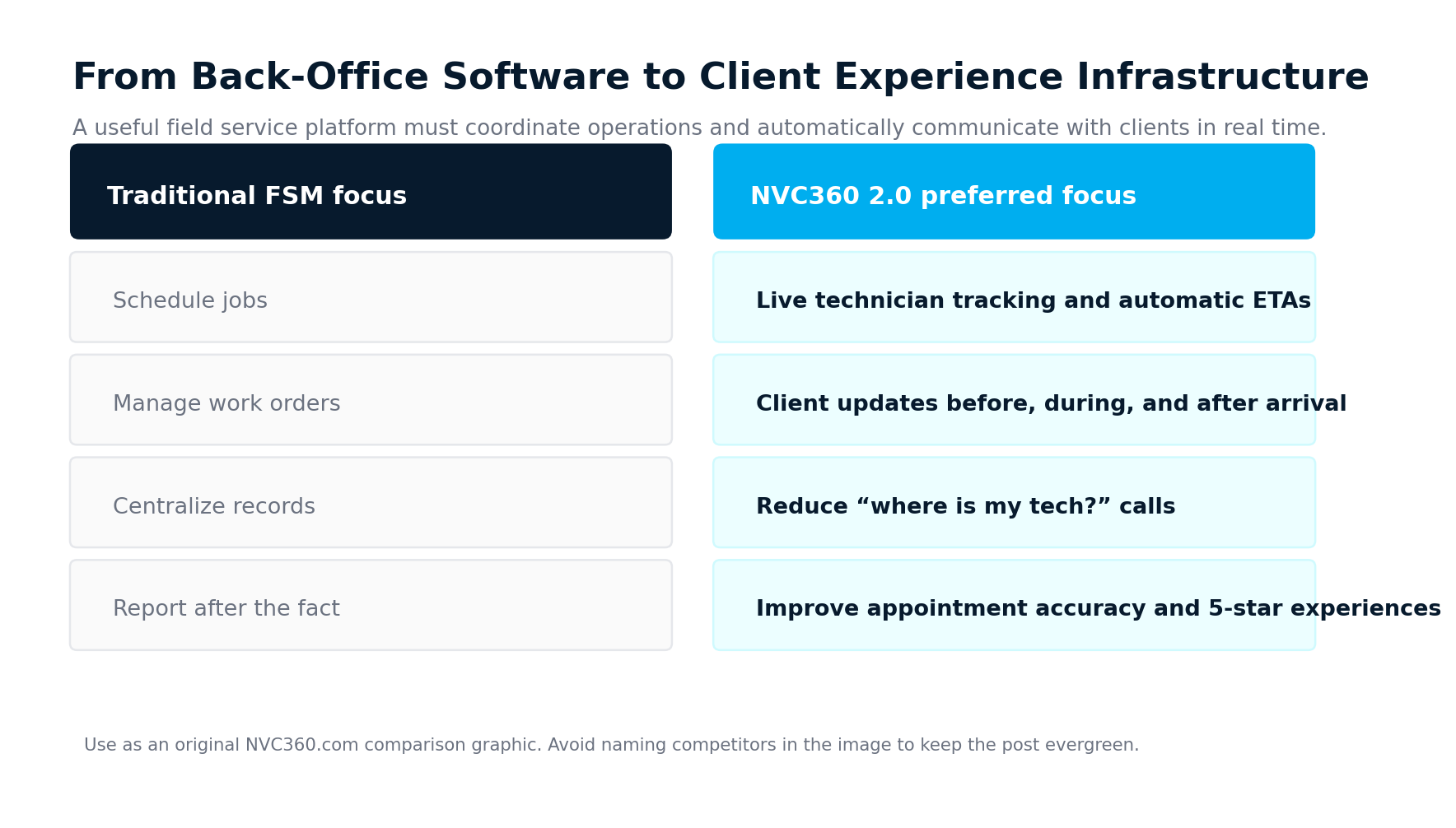
That is where NVC360 2.0 is built to stand apart. NVC360 2.0 focuses on live technician tracking, automatic ETAs, real-time client updates, and an “Uber-like” field service experience designed to reduce “where is my tech?” calls and help service teams deliver a more professional client experience.
Bottom line: In 2026, the preferred field service software is not simply the platform with the longest feature list. It is the platform that creates the clearest real-time picture for everyone involved: the dispatcher, the technician, the manager, and the customer.

There are solutions in the marketplace now…
ServiceTitan’s recent field service content has focused on AI-enabled automation, dispatch management, predictive maintenance, technician productivity, customer portals, augmented reality, route optimization, and data-driven decision-making. Its dispatch management guidance correctly identifies familiar operational problems, including information overload, poor technician matching, traffic delays, disconnected workflows, uncertain arrival times, and customers who do not know what is happening until they call.
Jobber’s recent content is more small-business and trade-specific. Its 2026 Home Service Trends Report reports that 75% of home service businesses expect revenue to grow in 2026, with one in five forecasting a significant jump. Jobber also reports that AI adoption has become mainstream, with more than half of home service businesses using AI for quoting, invoicing, and emails, and 88% of high-confidence businesses using AI compared with 27% of low-confidence peers.
| Competitor content theme | Why it is useful | What a better article must add |
| AI and automation | Shows that admin work is becoming a major productivity target. | Explain exactly where automation improves the customer experience, not just internal efficiency. |
| Dispatching and route optimization | Helps teams think about utilization, scheduling, and travel time. | Connect dispatch decisions to live ETAs, customer notifications, and fewer inbound status calls. |
| Customer portals and self-service | Gives customers more access to information. | Show why proactive communication is often better than asking customers to log in and check manually. |
| Trade-specific guides | Helps HVAC, plumbing, cleaning, delivery, and specialty contractors benchmark their market. | Provide an operating blueprint that works across field teams, not only one trade category. |
| Growth and pricing trends | Shows demand and confidence in the home service market. | Explain how to protect margin while demand grows by reducing labour waste and manual coordination. |
The gap is not that Jobber or ServiceTitan ignore operations. They do not. The gap is that many field service software conversations still treat customer communication as a secondary feature. In reality, communication is now part of the service itself.
The Customer Has Been Trained by Uber, Amazon, and Real-Time Logistics
The modern customer does not compare a technician visit only with another technician visit. They compare it with the apps they use every day. They can track a rideshare driver, a food delivery, a courier shipment, and an e-commerce order. When a service company gives a four-hour window and no update, the experience feels outdated before the technician even arrives.
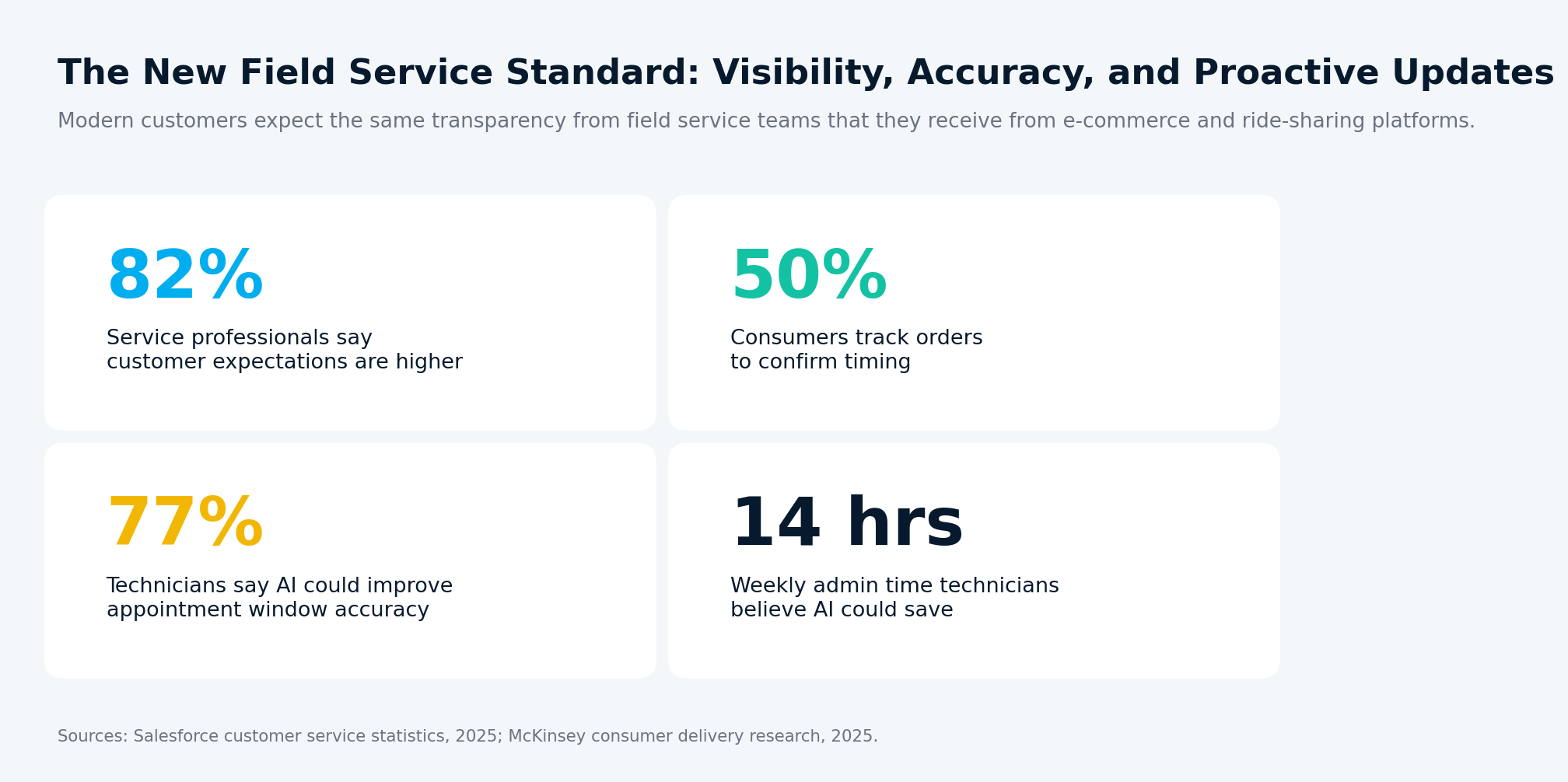
McKinsey’s 2025 research on U.S. delivery expectations found that consumers may accept slightly slower delivery if they have confidence that the order will arrive on time within the promised window. McKinsey also found that about 50% of respondents track order status to make sure the shipment is progressing and remains on time. The lesson for field service is straightforward: customers want confidence, not silence.
McKinsey notes that consumers become more forgiving when providers proactively communicate issues such as weather delays and offer options when expectations change.
For field service teams, this insight is critical. A late technician with no communication creates frustration. A delayed technician with an accurate ETA, a proactive update, and clear expectations can still protect trust. That is why real-time client communication is not a “nice-to-have.” It is the new baseline for professional field operations.
The Labour Problem Makes Visibility Even More Important
Field service businesses are operating in a labour-constrained environment. The U.S. Bureau of Labor Statistics projects employment of HVACR mechanics and installers to grow 8% from 2024 to 2034, much faster than the average for all occupations, with about 40,100 openings per year on average over the decade. More broadly, BLS projects installation, maintenance, and repair occupations to generate about 608,100 openings annually from 2024 to 2034.
That labour environment changes the economics of field service software. When skilled technicians are difficult to hire, expensive to train, and essential to customer satisfaction, service businesses cannot afford to waste technician time on avoidable admin, preventable callbacks, confusing routes, or manual status updates.
Salesforce’s current customer service statistics reinforce the same point. 82% of service professionals say customer expectations are higher than they used to be, while 81% of technicians believe AI agents could help them work more efficiently. Salesforce also reports that 77% of technicians believe AI agents could improve appointment window accuracy, and technicians estimate AI could handle 35% of administrative tasks, saving about 14 hours per week.
| Operational pressure | What it creates | What NVC360 2.0 helps solve |
| Higher customer expectations | More calls asking for technician status, arrival time, and confirmation. | Automated ETAs and real-time client updates reduce uncertainty. |
| Limited technician capacity | Every wasted drive, delay, and admin task becomes more expensive. | Live visibility helps managers and dispatchers coordinate work more effectively. |
| Dispatcher overload | Teams rely on calls, texts, and manual follow-up to understand what is happening. | A centralized view of field activity reduces the need to chase updates. |
| Rising service demand | Growth can create operational chaos if communication does not scale. | Customer communication automation helps protect service quality as job volume grows. |
| Competitive pressure | Customers choose providers who feel organized, responsive, and professional. | NVC360 2.0 supports an Uber-like experience that can improve perceived professionalism. |
Why Traditional Field Service Software Is No Longer Enough
Traditional field service management software usually starts with the back office. It helps organize jobs, assign technicians, manage work orders, collect notes, and maintain records. Those capabilities are valuable, but they are only one side of the service experience.
The customer experiences the job differently. They experience the wait. They wonder whether the technician is actually coming. They call the office for updates. They judge professionalism before the work begins. They remember whether the company made the process easy.
This is why NVC360 2.0’s positioning around an Uber-like field service experience is timely. NVC360 2.0 is designed around live technician tracking, automatic ETAs, and client updates that reduce uncertainty before the truck arrives. That means the software is not just helping the business “manage jobs.” It is helping the business manage trust.
The NVC360 2.0 Advantage: Real-Time Clarity Without Unnecessary Complexity
NVC360 2.0 is especially compelling because it addresses one of the biggest market frustrations: software complexity. Service companies do not need another system that adds work for dispatchers, technicians, or customers. They need software that simplifies the experience while making the business look more professional.
NVC360 2.0 is positioned as a real-time field operations and client communication platform built by operators who have managed large field teams. That operating DNA matters. A platform designed by people who understand dispatch pressure, technician movement, customer impatience, and the cost of poor visibility is more likely to solve the daily problems that actually slow field teams down.
| What field teams need in 2026 | Why it matters | How NVC360 2.0 supports the need |
| Live technician tracking | Managers need to know where work is happening without constant calls. | NVC360 2.0 emphasizes live technician visibility and real-time operational awareness. |
| Automatic ETAs | Customers want accurate arrival expectations, not vague service windows. | NVC360 2.0 is built around automatic ETAs and proactive client updates. |
| Fewer inbound status calls | “Where is my tech?” calls consume office time and frustrate customers. | NVC360 2.0 specifically positions itself around reducing those calls. |
| Better client experience | The service experience starts before the technician arrives. | NVC360 2.0 helps companies deliver an Uber-like customer experience. |
| Lower labour waste | Labour is expensive, capacity is tight, and admin time adds up. | NVC360 2.0’s focus on visibility and automated updates supports less manual coordination. |
The result is a clearer value proposition than a generic “all-in-one” promise. NVC360 2.0 helps field service businesses look organized, communicate proactively, and coordinate field work with less friction.
The 2026 Field Service Operating Blueprint
To outrank generic field service software content, it is not enough to describe features. Operators need a practical blueprint. The most effective field service companies in 2026 will use technology to improve three connected areas: visibility, communication, and execution.
1. Replace Static Service Windows With Live ETA Confidence
A static appointment window may be easy to schedule, but it creates uncertainty for the customer. Real-time ETAs create a better experience because the customer can plan their day with confidence. When the technician is delayed, the customer should not need to call the office. The system should update them proactively.
This is where field service software directly influences customer satisfaction. McKinsey’s finding that about half of consumers track order progress shows that people want reassurance that the promise is still on track. Field service companies should treat arrival visibility as a core part of the service experience, not as an optional add-on.
2. Automate the Updates That Dispatchers Repeat All Day
Many field service offices lose time to repetitive communication. Dispatchers confirm appointments, answer status calls, ask technicians for location updates, explain delays, and reassure customers. Those tasks matter, but they should not require constant manual effort.
Salesforce’s finding that technicians believe AI could handle a meaningful share of administrative tasks reinforces the broader direction: field teams need systems that remove avoidable admin from the day. NVC360 2.0’s automated client updates and ETA communication are aligned with that need.
3. Give Managers a Real-Time View of the Field
A dispatcher cannot manage what they cannot see. When technician locations, job status, delays, and customer expectations are spread across phone calls, texts, and disconnected systems, the business becomes reactive. Real-time field visibility changes the operating rhythm. Managers can spot issues earlier, reassign work more intelligently, and reduce the time wasted trying to reconstruct what happened after the fact.
ServiceTitan’s dispatch content correctly highlights the operational risk of disconnected workflows, route issues, technician mismatch, and poor customer communication. NVC360 2.0’s opportunity is to make those problems easier to solve for teams that want clarity without enterprise-level complexity.
4. Use Communication as a Differentiator, Not a Cost Center
Customer communication is often treated as overhead. That is a mistake. In field service, communication is part of the product. A customer may not know whether the technical work is excellent until after the job is complete, but they know immediately whether the company feels organized, responsive, and respectful of their time.
NVC360 2.0’s “Make your clients love you” positioning is effective because it focuses on the outcome customers notice: confidence, visibility, and reduced uncertainty.
5. Make Growth Operationally Sustainable
Jobber’s 2026 report suggests optimism across the home service market, with 75% of businesses expecting revenue growth. Growth is positive, but growth without operational discipline creates service failures. More calls, more appointments, more technicians, and more customer expectations can overwhelm a team that still relies on manual coordination.
The companies that scale best will use field service software to reduce the coordination burden per job. That means fewer manual updates, fewer preventable calls, clearer ETAs, and a better shared view of daily execution.
Why NVC360 2.0 Is the Preferred Field Service Software Choice for Modern Operators
NVC360 2.0 should be considered a preferred field service software solution for service companies that want a practical, customer-facing operating advantage rather than another complicated back-office system. The platform’s strongest value is its focus on the exact moments that shape the client experience: technician assignment, travel visibility, ETA communication, arrival confidence, and reduced inbound uncertainty.
This matters because the market is moving toward software that does more than store job information. The best platforms now coordinate labour, automate communication, and create a more transparent relationship between the field team and the customer.
| Decision factor | Why it matters in 2026 | NVC360 2.0 position |
| Customer experience | Customers expect transparency similar to rideshare and delivery apps. | NVC360 2.0 is built around an Uber-like service experience. |
| Operational simplicity | Teams do not want software that adds more steps. | NVC360 2.0 emphasizes real-time clarity and automated communication. |
| Dispatcher productivity | Manual status updates consume valuable office time. | NVC360 2.0 helps reduce “where is my tech?” calls. |
| Technician utilization | Labour constraints make every wasted hour more expensive. | NVC360 2.0 supports better field coordination through live tracking and visibility. |
| Growth readiness | Demand is strong, but growth can expose weak systems. | NVC360 2.0 helps service businesses scale communication without adding proportional admin load. |
A More Useful Field Service Software Checklist for 2026
Before choosing field service software, operators should ask more than whether the platform can schedule jobs or create invoices. Those functions are important, but they are not enough to create a differentiated service experience.
A stronger evaluation should ask whether the software helps answer the questions customers and managers care about most.
| Evaluation question | Why it matters |
| Can customers see accurate arrival expectations without calling the office? | This reduces uncertainty and improves perceived professionalism. |
| Can dispatchers see field activity in real time? | This allows faster decisions and fewer manual check-ins. |
| Can the system automatically update customers when timing changes? | Proactive communication protects trust when delays happen. |
| Can technicians spend less time on admin and more time completing work? | Labour capacity is a strategic constraint, not just an HR issue. |
| Can the platform improve the customer experience before the technician arrives? | The service impression starts before the work begins. |
| Can the business grow without adding more manual coordination? | Growth should not require a proportional increase in office workload. |
NVC360 2.0 is designed for companies that answer “yes” to these priorities. Its focus on live tracking, automatic ETAs, and customer communication makes it especially relevant for businesses that want to modernize the experience without burying their team in unnecessary complexity.
Final Takeaway
The next generation of field service software will not be defined only by scheduling, invoicing, or back-office administration. Those capabilities matter, but they are increasingly expected. The real advantage is the ability to create real-time trust.
Customers want to know when the technician is coming. Dispatchers want to know where the team is. Managers want fewer blind spots. Technicians want less admin. Businesses want to grow without sacrificing service quality. The data points in the same direction: customer expectations are rising, AI and automation are becoming normal, labour capacity is tight, and the field service management software market is growing quickly.
That is why NVC360 2.0’s focus on live technician tracking, automatic ETAs, and proactive client communication is so relevant. It speaks to the practical operating reality of service companies in 2026: the best customer experience is not created after the job is done. It begins the moment the customer knows exactly what is happening.
Ready to deliver an Uber-like experience for your clients? Explore NVC360 2.0 and see how real-time field visibility, automatic ETAs, and proactive communication can help your team reduce uncertainty, improve professionalism, and scale with confidence.
References
[1] ServiceTitan: Top Field Service Trends
[2] ServiceTitan: Dispatch Management
[3] Jobber: HVAC Industry Trends
[4] Jobber: 2026 Home Service Trends Report
[5] McKinsey: What do US consumers want from e-commerce deliveries?
[6] Salesforce: Latest Customer Service Statistics
[7] Fortune Business Insights: Field Service Management Market
[9] U.S. Bureau of Labor Statistics: HVACR Mechanics and Installers
[10] U.S. Bureau of Labor Statistics: Installation, Maintenance, and Repair Occupations
Alright alright alright, okkingnhacai, eh? Gives you that royal feeling, doesn’t it? Worth a punt, I reckon! okkingnhacai
888b gay sounds fun. It could be great or it could be crazy. What do you guys think? Have any of you checked it out yet? 888b gay
Yo, W88vt, what’s up? Heard good things about your slots. Gonna give it a shot later tonight. Hope the odds are in my favor! Click here to see w88vt!
vardenafil warning guidance
vardenafil warning guidance
medical review methodology
medical review methodology