Growth Is No Longer Enough
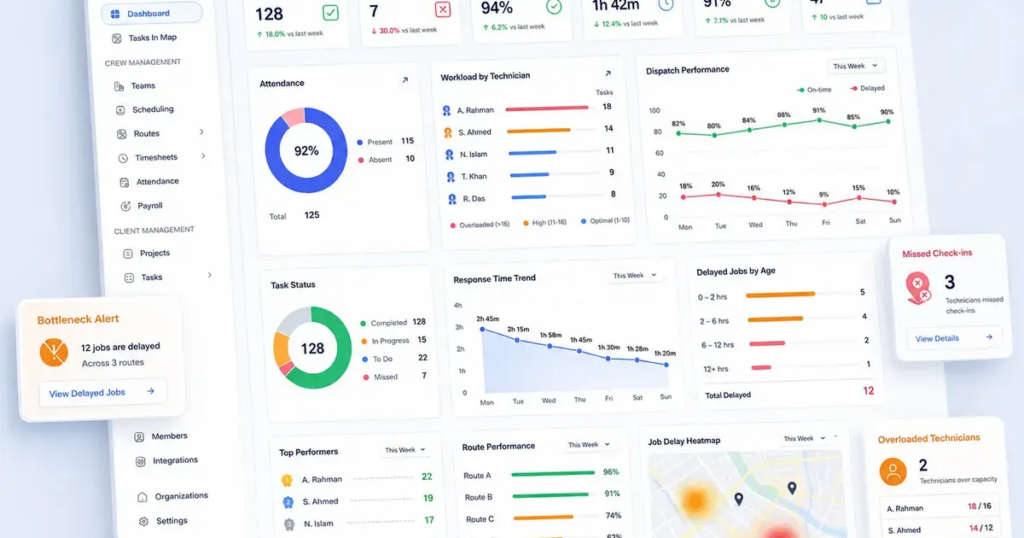
For years, the dominant message in the trades was simple: grow revenue, digitize the business, scale the team, and capture more market share. That message made sense in a market where demand was strong, software adoption was still early, and many contractors were moving from paper, spreadsheets, and disconnected systems into modern field service platforms.
But the market is changing. The companies that win the next decade in HVAC, plumbing, electrical, construction, delivery, specialty trades, and field service will not be the companies that only sell more. The winners will be the companies that execute better operationally. They will protect margins, use technician time more effectively, dispatch with precision, automate routine communication, retain more customers, and know exactly which marketing dollars are turning into profitable booked work.
This is not a small copywriting adjustment. It is a major strategic shift in how trades businesses should think about technology. The older promise was often about revenue growth, digital transformation, and scaling. The new promise is more disciplined: profitability, technician productivity, dispatch efficiency, automation, marketing ROI, customer retention, and reduced wasted overhead.
Current category messaging reflects this shift. ServiceTitan’s public homepage now leads with language about “maximizing net profits,” “lifetime value of customers,” and “improving workforce productivity,” while its commercial software positioning emphasizes “better profit margins,” “faster cash flow,” and workflows that encourage productivity.1 That matters because it signals where the category is moving. Trades leaders are no longer asking whether software can help them grow. They are asking whether software can help them operate cleanly enough for growth to remain profitable.
The new question for every trades business is not, “Can we book more work?” It is, “Can we complete the right work, with the right technician, at the right margin, while giving the customer a reason to call us again?”
The High Cost of Inefficiency
Operational waste used to be treated as a normal cost of doing business. A technician drove across town for the wrong job. A dispatcher spent the afternoon calling customers with appointment updates. A customer called three times asking where the technician was. A manager could not tell which marketing campaign produced profitable booked jobs. A crew returned to the same site because the first visit did not solve the problem.
Those issues are no longer minor irritations. They are margin leaks. When labor is scarce, wages are higher, customer expectations are rising, and schedules are under pressure, every wasted hour becomes expensive.
The labor market alone makes the case. The U.S. Bureau of Labor Statistics projects construction and extraction occupations will grow faster than the average for all occupations from 2024 to 2034, with roughly 649,300 openings each year due to growth and replacement needs.2 The AGC/NCCER 2025 Workforce Survey found that 88% of firms directly employing craft workers had craft-worker openings, and 83% of firms with craft openings said those roles were as hard or harder to fill than a year earlier.3
That same AGC/NCCER survey reported that 45% of respondents experienced project delays because of shortages of their own workers or subcontractors’ workers, while 78% reported at least one delayed project.3 The message is clear: labor is too valuable to waste on avoidable administrative work, bad routing, poor communication, preventable repeat visits, or manual follow-up.
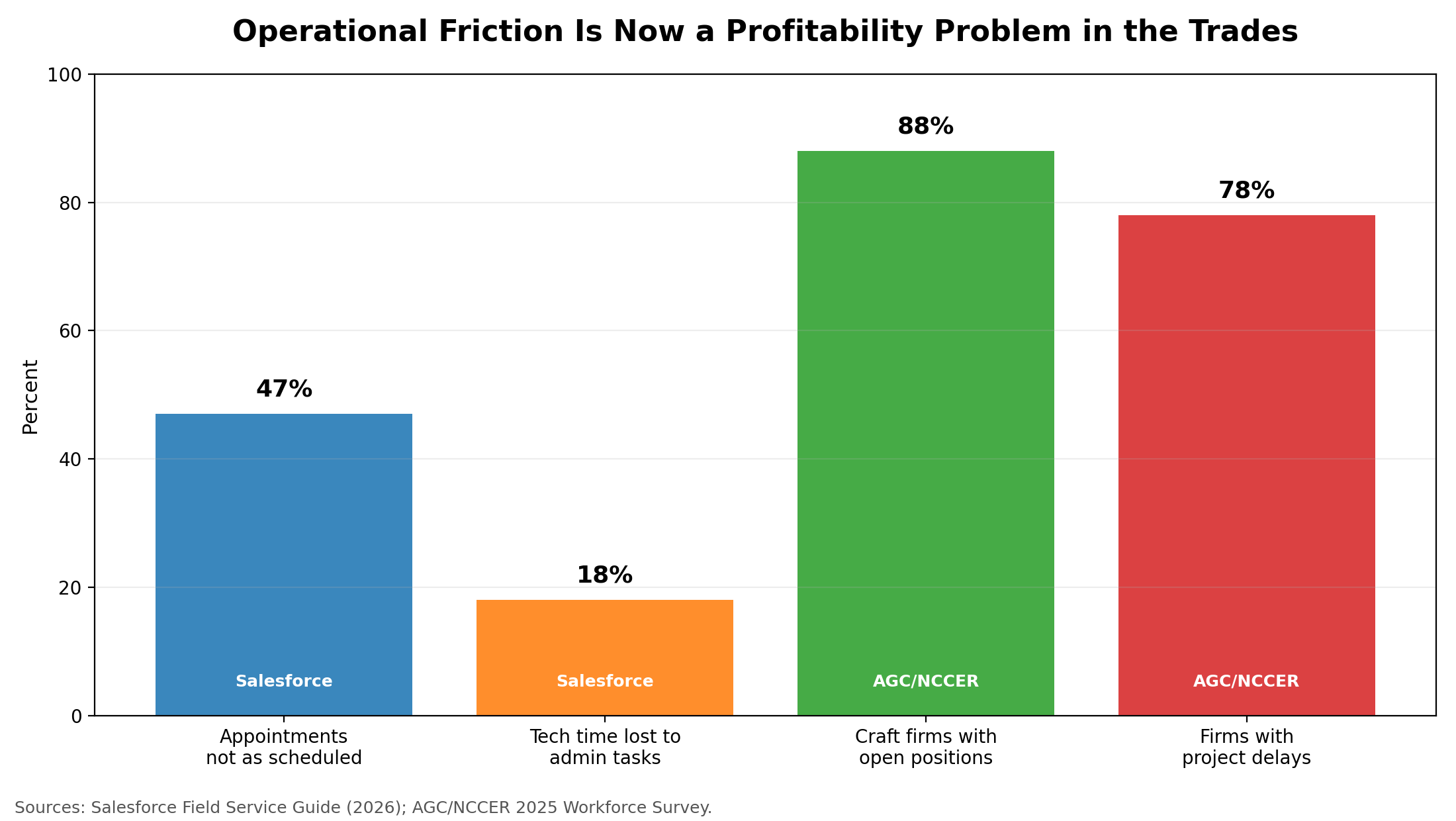
Customer-facing field service organizations are feeling similar pressure. Salesforce’s 2026 field service research reported that 47% of appointments do not go as scheduled, technicians lose 18% of working hours, or more than seven hours per week, to administrative tasks, and 66% of technicians experience burnout monthly.4 Salesforce also reported that scheduling an appointment takes 17 minutes, changing one takes 15 minutes, and even cancellations consume 12 minutes.4
| Operational friction point | Why it matters to profitability | What leaders should measure |
| Failed or changed appointments | Every schedule disruption creates dispatcher work, customer frustration, and technician downtime. | On-time arrival rate, reschedule rate, cancellation time, customer notification response time. |
| Technician administrative burden | Skilled labor should be solving customer problems, not chasing forms, updates, and missing information. | Billable utilization, admin time per technician, job closeout time, mobile form completion time. |
| Poor dispatch visibility | Sending the wrong technician or creating inefficient routes burns time, fuel, and customer patience. | Average travel time, first-time fix rate, jobs per tech per day, repeat visit rate. |
| Weak customer communication | If customers have to call for updates, the office becomes the tracking system. | Inbound “where is my tech?” calls, automated status update rate, review rate, repeat booking rate. |
| Unclear marketing attribution | Revenue growth can hide poor lead quality and unprofitable acquisition channels. | Cost per booked job, lead-to-booked rate, revenue per campaign, gross margin by campaign. |
The strategic issue is not whether trades businesses need more demand. Many do. The issue is that demand without operating discipline can create chaos. More calls can overwhelm dispatch. More jobs can expose weak handoffs. More technicians can create more management overhead. More marketing spend can increase revenue while lowering profit.
This is why the winners will be the companies that improve the operating system underneath the growth engine.
The New Trades Playbook: Profit Per Job, Not Just Revenue Per Month
Revenue is still important, but revenue is not the same as profit. A growing company can still become less healthy if every additional dollar requires more overhead, more manual coordination, more repeat work, and more management intervention.
The new playbook starts with a simple premise: every job should be easier to schedule, easier to communicate, easier to complete, easier to invoice, and easier to learn from than the job before it. That is the operational flywheel.
ServiceTitan’s own field service metrics content reflects this type of operating discipline. It highlights KPIs such as call booking rate, job rate per day, average response time, mean time to repair, mean time to complete a job, first-time fix rate, repeat visit rate, technician utilization, and average travel time.5 These are not vanity metrics. They are the numbers that show whether a field service company is turning labor, time, and customer demand into profitable execution.
A company that wants to win operationally should build its scorecard around the following logic.
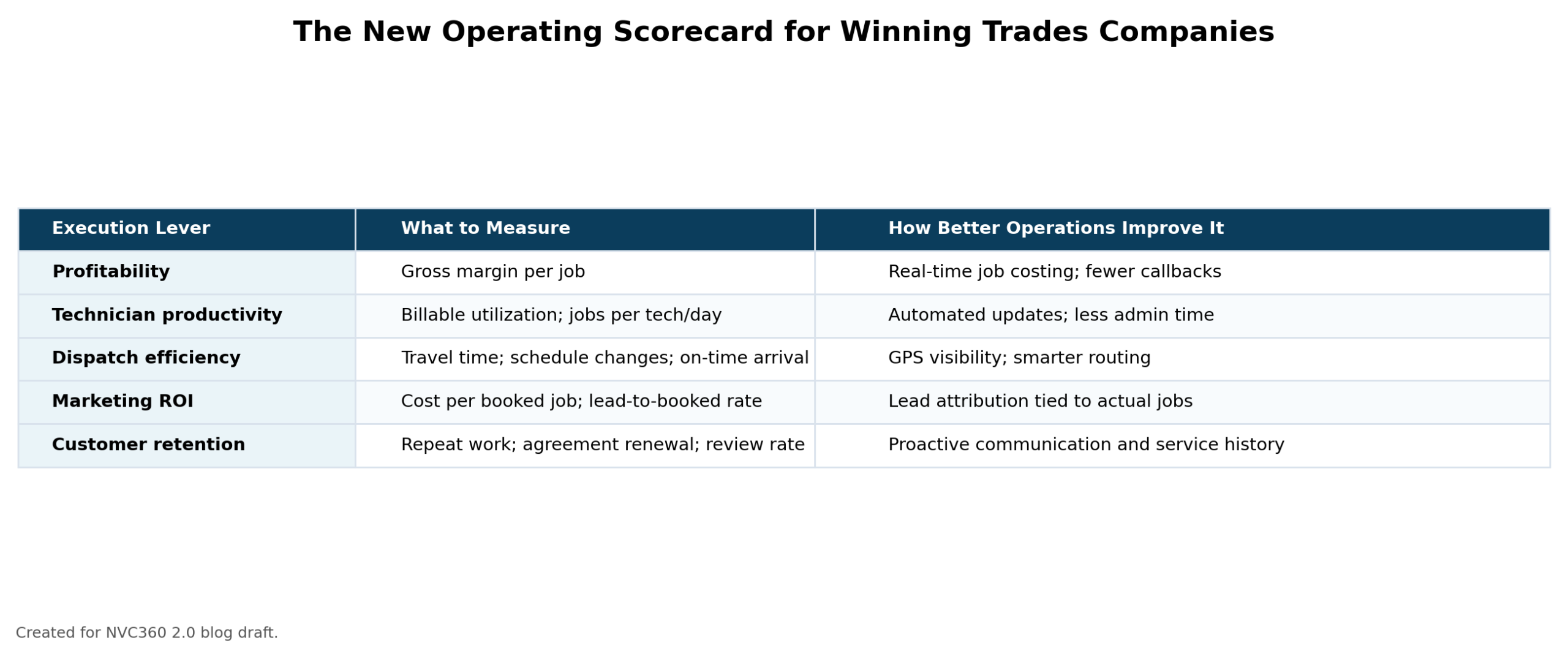
| Strategic priority | Old growth-era question | New execution-era question |
| Revenue growth | How do we get more leads and book more jobs? | Which leads become profitable jobs, repeat customers, and strong reviews? |
| Technician productivity | How many technicians can we add? | How much billable, productive time can we protect for every technician we already have? |
| Dispatch efficiency | How do we keep the schedule full? | How do we send the right technician to the right job with the least wasted travel and the highest chance of first-visit completion? |
| Automation | How do we digitize our process? | Which manual touchpoints can be automated without hurting the customer experience? |
| Marketing ROI | How much revenue did campaigns create? | What was the cost per booked job, and what margin did those jobs generate? |
| Customer retention | How do we win new customers? | How do we create a service experience that makes customers want to come back and refer us? |
| Overhead control | How do we support more work? | How do we handle more work without adding unnecessary administrative headcount? |
This distinction matters because many trades businesses have grown by adding people to solve process problems. When the phones get busy, they add office staff. When schedules get messy, they add dispatcher hours. When customers complain, managers intervene manually. When technicians miss details, supervisors chase paperwork.
That model becomes fragile in a tighter labor market. The better model is to reduce the need for manual intervention in the first place.
Technician Productivity Is the New Capacity Strategy
In the past, a contractor’s capacity strategy often meant hiring more technicians. Today, hiring is still necessary, but it is not sufficient. The labor market is too tight, the hiring cycle is too long, and skilled people are too expensive to treat productivity as a secondary issue.
The better question is: how much productive capacity is already trapped inside the current team?
Salesforce’s research found that technicians lose more than seven hours per week to administrative tasks.4 If that burden can be reduced, even partially, the business does not just become more efficient. It effectively creates capacity without hiring. Salesforce also reported that 81% of technicians believe AI agents could help them work more efficiently, and technicians estimated that AI could handle 35% of their administrative tasks.4
For trades leaders, this should change the technology conversation. Automation should not be viewed only as a corporate efficiency initiative. It should be viewed as a technician enablement strategy. The goal is not to replace skilled workers. The goal is to give them more of their day back for the work only they can do.
Technician productivity improves when the job details are clear before arrival, the customer knows when the technician is coming, the technician has the right information on-site, the office does not need to interrupt the field team for status updates, and job closeout happens cleanly from the mobile workflow. These are operational details, but they compound into real margin.
Dispatch Efficiency Is Where Profitability Is Won or Lost Daily
Dispatch is one of the most important profit centers in a trades business, even though it is rarely treated that way. Every dispatch decision affects travel time, customer satisfaction, technician utilization, first-time fix rate, and the number of jobs the company can complete in a day.
Poor dispatching does not always look dramatic. It often looks like small daily inefficiencies: a technician crossing another technician’s territory, a customer not being notified soon enough, a dispatcher manually calling to confirm arrival windows, or a technician arriving without full context. Each instance may seem manageable. Over hundreds or thousands of jobs, the cost becomes significant.
ServiceTitan’s field service metrics guidance identifies average travel time, technician utilization, repeat visit rate, job rate per day, and first-time fix rate as important operational indicators.5 These metrics belong together because they describe the same economic reality: a company makes money when technicians spend more time doing valuable work and less time waiting, driving unnecessarily, searching for information, or returning to unfinished jobs.
The ideal dispatch experience should feel familiar to customers because consumers already understand real-time visibility from companies like Uber, Amazon, and pizza delivery platforms. Customers do not want to wonder whether someone is coming. They want status, transparency, and confidence.
This is where NVC360 2.0 fits the modern operational challenge. NVC360 2.0 is built around the idea that field operations and client communication should not be separated. When customers receive timely updates and teams have real-time visibility, the business reduces avoidable calls, manual coordination, and uncertainty. The customer gets a modern, “Uber-like” experience, and the company gets a cleaner operating model.
Marketing ROI Must Be Connected to Operations
In the old growth model, marketing success was often measured by leads, calls, or total revenue. In the new execution model, marketing success must be measured by profitable booked work.
A campaign that generates many calls but low-quality jobs can drain a business. A promotion that fills the schedule but creates low-margin work may not be a win. A lead source that looks impressive at the top of the funnel can underperform once call booking rate, dispatch fit, technician time, parts availability, callbacks, and customer retention are considered.
This is why marketing ROI can no longer live in a separate dashboard from operations. The right question is not only, “Which campaign generated leads?” The better question is, “Which campaign generated jobs we could execute efficiently, complete profitably, invoice quickly, and convert into long-term customers?”
That requires connecting lead source, booked job, technician assignment, job outcome, margin, review, and repeat activity. When the operating data and customer communication data are connected, leadership can make better decisions about where to spend, where to stop spending, and where to improve the customer journey.
Retention Is a Profit Strategy, Not Just a Customer Service Goal
Customer retention is often discussed as a relationship metric, but it is also a financial metric. Bain’s loyalty research famously found that increasing customer retention rates by 5% can increase profits by 25% to 95%.6 Even though that statistic is not trades-specific, the principle is especially relevant to field service: repeat customers are typically easier to serve, easier to communicate with, and more likely to trust recommendations from technicians.
Retention improves when customers feel informed and respected. That means clear arrival windows, proactive updates, accurate documentation, easy communication, and confidence that the company knows what happened on prior visits. A customer who has to chase the office for information is less likely to become loyal. A customer who receives timely updates and a professional service experience is more likely to call again.
This is why operational execution and customer experience are now inseparable. The customer experiences your operations. If dispatch is messy, the customer feels it. If technician handoffs are poor, the customer sees it. If communication is manual and inconsistent, the customer notices. If the business is organized, transparent, and responsive, that becomes part of the brand.
A Better Way: Build the Operating Layer Between the Office, Field, and Customer
The next generation of field service technology must do more than store information. It must coordinate action. The businesses that win will create a connected operating layer between the office, the field, and the customer.
That operating layer should make it easy to know where technicians are, what job status has changed, what customers have been told, what work is ready to invoice, what issues require attention, and where overhead is being created unnecessarily. It should reduce the number of times a dispatcher has to manually update a customer. It should reduce the number of calls asking for status. It should make the service experience feel modern without forcing the customer to learn a complicated portal.
This is the practical value of NVC360 2.0. It helps field service and specialty trades companies deliver the kind of real-time communication customers now expect, while giving the business more visibility and control over daily execution. The result is not technology for its own sake. The result is fewer communication gaps, less wasted overhead, better customer confidence, and a more scalable operating rhythm.
The “Uber-Like” Experience in Action
Imagine a busy HVAC company on the first hot week of summer. Calls are coming in quickly. The dispatch board is full. Technicians are moving from job to job. Customers are anxious because their homes are uncomfortable, and every missed update becomes another inbound call to the office.
In the old model, the dispatcher becomes the communication hub. Customers call for updates. Technicians text when they can. Office staff manually relay information. Managers step in when the day gets chaotic. Everyone is working hard, but the system depends on human memory and manual follow-up.
In the new model, customers receive timely status updates automatically. The office sees job progress more clearly. Technicians are not interrupted as often. Customers know when help is on the way. The business reduces avoidable calls and keeps the day moving. The technician still performs the skilled work, but the communication layer around that work becomes smoother, faster, and more professional.
That is the operational advantage. It is not only about delighting the customer, although that matters. It is about protecting the company’s capacity, margin, and reputation during the exact moments when the business is under pressure.
The Future Belongs to Operators
The trades are entering an execution era. Growth still matters, but growth without operating discipline is risky. The companies that win will be the ones that understand their numbers, protect technician time, dispatch intelligently, automate routine communication, hold marketing accountable to profitable jobs, retain more customers, and reduce wasted overhead.
The strategic shift is already visible across the industry. Messaging that once focused mainly on digital transformation and scaling is now moving toward profitability, cash flow, productivity, retention, and operational confidence. That shift is not cosmetic. It reflects what owners and operators are experiencing every day: the path to better growth now runs through better execution.
For field service companies, specialty trades, and mobile workforce businesses, the opportunity is clear. Build an operating model that gives customers real-time confidence, gives technicians more productive time, and gives managers better visibility into what is actually happening. That is how companies protect margin. That is how they improve service. That is how they become preferred.
Ready to reduce wasted overhead and deliver a more modern field service experience?
NVC360 2.0 helps field service teams streamline communication, improve real-time visibility, and create an “Uber-like” experience for customers and crews. See how NVC360 2.0 can help your business execute better operationally.
References
1.ServiceTitan, “Home and Commercial Software for the Trades,” accessed May 19, 2026. ↩
2.U.S. Bureau of Labor Statistics, “Construction and Extraction Occupations,” Occupational Outlook Handbook, last modified August 28, 2025. ↩
3.[Associated General Contractors of America and NCCER, “2025 Workforce Survey Analysis,” 2025](https://www.agc.org/sites/default/files/users/user21902/2025%20Workforce%20Survey%20Analysis%20(3 ).pdf). ↩ ↩2
4.Salesforce, “3 Field Service Trends Today’s Leaders Need to Know,” January 30, 2026. ↩ ↩2 ↩3 ↩4
5.ServiceTitan, “19 Key Field Service Metrics for Tracking Performance in 2026,” November 28, 2025. ↩ ↩2
6.Bain & Company, Frederick F. Reichheld, “Loyalty Rules! Chapter One,” citing the customer-retention profit impact of loyalty. ↩
toradol short term warnings
toradol short term warnings
Heard about Fortune Games 2 on Jililiveph.Net. Gave it a try and it’s not bad at all! Fun little game, worth a few spins to unwind. Don’t forget to pay a visit to fortune games 2
Alright, so I went to wowph125. The site works just like your average online casino. I would recommend if you are looking for one to play at! Go to wowph125 and see what you think!
Shbetf on shbetf.info is legit! Found some cool games I haven’t seen anywhere else. Give it a whirl, might be your new favorite spot. Go check it out shbetf
vardenafil vs sildenafil duration comparison
vardenafil vs sildenafil duration comparison